
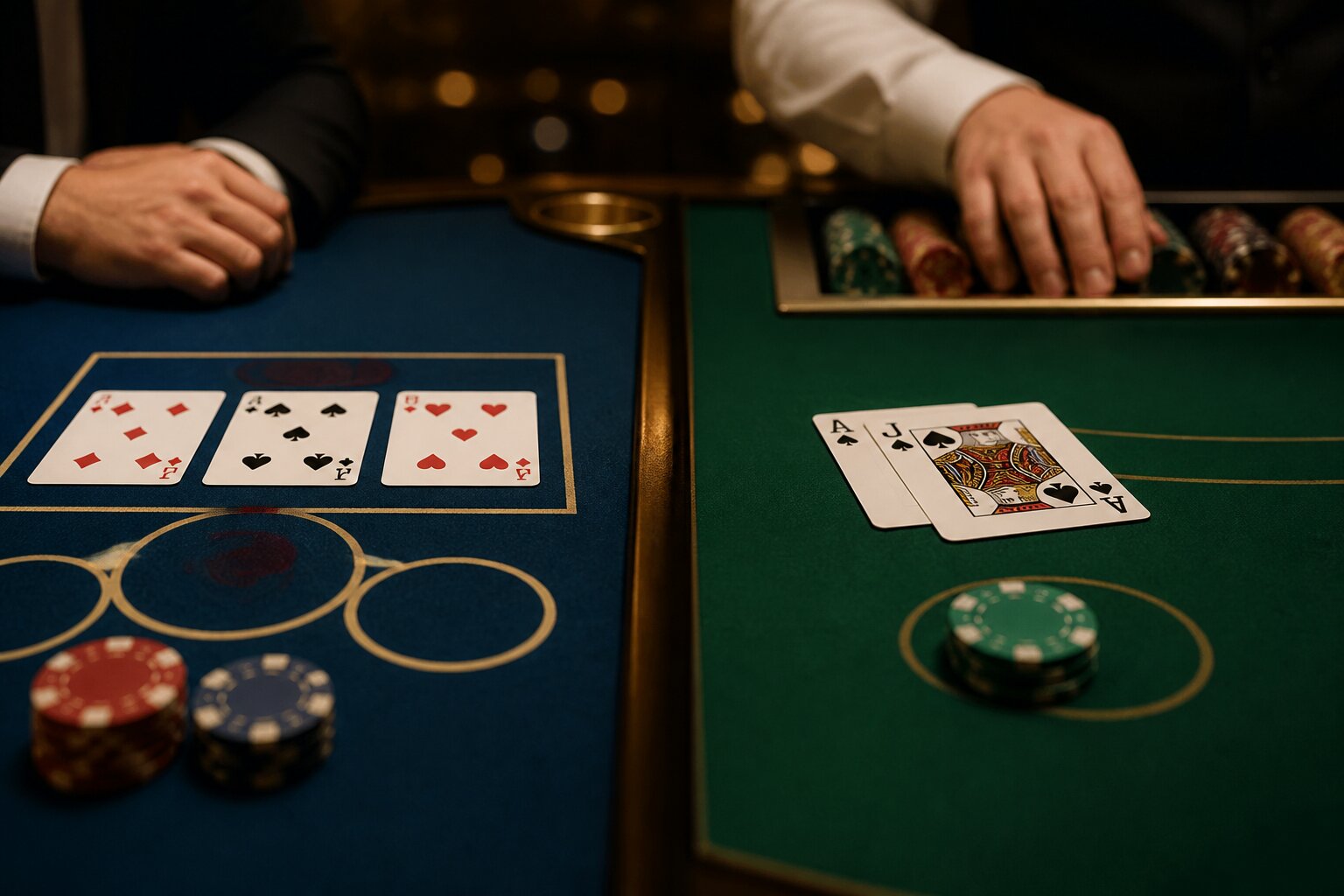
Ever sat at a card table and wondered whether 3 Card Poker and blackjack are really all that different, or if it’s just the rules and the dealer’s fancy shuffle that set them apart? Perhaps a mate’s sworn that counting cards in one game means you’ll crack the other, or that patterns at the table will tell you everything. The appeal of these classic casino games is strong, but the myths and half-truths around them can make things needlessly confusing.
Many players second-guess what strategy works, convinced that a streak or a system will trump the maths. Before you place your next bet, it helps to separate common beliefs from how the games actually work at the felt. We’ll strip away the myths, compare rules and objectives, and show how player choices and house rules shape each game’s experience.
Read on to learn the real differences and what they mean for how you play.
The casino floor often echoes with snippets of advice from seasoned regulars and newcomers alike—most of it well-meaning, but not always accurate. These popular beliefs become widely accepted and can leave players unsure about what’s true, especially when comparing favourites like 3 Card Poker and blackjack.
Popular Misconceptions About Casino Table Games
Do All Casino Games Have the Same House Edge?
A common notion is that all casino games are “rigged” the same way, with a single fixed house edge across the board. In reality, house edge varies significantly between games and even between different bets within the same game.
For example, the main Ante bet in 3 Card Poker typically has a house edge around 3.37%, while the Pair Plus side bet usually carries a higher edge because it pays for stronger hands regardless of the dealer’s cards. Blackjack is different: with correct basic strategy, the house edge can fall as low as about 0.5%, though it rises quickly if players make suboptimal decisions or take particular side bets.
These figures illustrate that the casino’s advantage depends on the rules, paytables and the choices players make. Knowing which bets reduce the edge is part of making better-informed decisions at the table. That background will help when we look at how each game is actually played.
Is It Possible to Predict Game Outcomes?
Another widespread belief is that spotting patterns, tracking past hands or sitting at a “hot” table will give a player the upper hand. Some think card counting or noting previous results works the same way in every game.
In blackjack, card counting can affect long-run probabilities in very specific conditions — for instance, when there are few decks and the shoe is not frequently reshuffled. In most modern live casino settings, automatic shufflers, multiple decks and strict floor rules make effective counting impractical. Using aids such as devices or detailed notes is prohibited and can lead to ejection from the venue.
In 3 Card Poker, trying to track previous hands offers no advantage. Each three-card deal is independent; there isn’t an evolving composition of the deck in play the way there can be in single- or few-deck blackjack shoes. Both games rely on random shuffling methods to deliver unpredictable outcomes, so observing past hands won’t reliably predict future results.
Understanding these mechanics prevents chasing patterns that don’t exist and keeps play focused on the choices that do matter. Next, we’ll unpack the rules so those choices become clearer.
Understanding the Basic Rules: 3 Card Poker vs Blackjack
3 Card Poker
3 Card Poker is a fast game where each player faces the dealer. Play begins with an Ante bet. Both player and dealer receive three cards, and the player chooses either to fold or to place a Play bet equal to the Ante.
After that choice, the dealer reveals their hand. The dealer must have at least a Queen high to qualify; if they don’t, the player typically wins even money on the Ante and the Play bet is returned. If the dealer qualifies, hands are compared using standard three-card hand rankings—high card up to straight flush—and the higher hand wins. The Pair Plus side bet is independent: it pays when the player’s three cards contain a pair or better, regardless of the dealer’s hand.
Pacing is brisk and decisions are limited, which makes the game straightforward to learn but largely dependent on the card strength you’re dealt. With this rule set in mind, the differences with blackjack become easier to spot.
Blackjack
Blackjack is a value-driven game where the aim is to form a hand total as close to 21 as possible without exceeding it. Cards 2–10 are worth face value, face cards count as 10 and aces can count as 1 or 11. Players and the dealer receive two cards to start; player cards are usually face up and the dealer shows one card face up and one face down.
Players have multiple choices during a round: they can hit to take another card, stand to keep their total, double down (doubling the bet in exchange for one final card) or split pairs into two hands. The dealer follows fixed rules, typically drawing until reaching 17 or higher. Blackjack (an ace with a ten-value card) usually pays 3:2 unless rules state otherwise.
Blackjack offers a richer decision set than 3 Card Poker, and those choices directly influence the mathematically optimal play. With the rules clear, it’s useful to consider how the differing objectives shape table behaviour.
Game Objectives Compared: What Are You Trying to Achieve?
Objectives differ because the games test different skills and prompt different strategies. In 3 Card Poker the goal is to assemble the strongest possible three-card hand to beat the dealer’s hand. Success hinges on recognising hand strength—knowing when a hand like a pair or a straight flush is likely to hold up—and deciding whether that strength justifies matching the Ante.
In blackjack the objective is numerical: obtain a hand total that beats the dealer without exceeding 21. This shifts the emphasis to probabilistic decision-making. A hand of 16 against a dealer’s 6 carries a different strategic value than the same total facing a dealer’s 10; the player’s choices reflect those changing odds. Blackjack rewards players who understand when the statistical expectation favours a hit, stand, double or split.
Both objectives pit the player directly against the dealer, but they do so in distinctly different ways. Where 3 Card Poker reduces choices to a single decision after the deal, blackjack requires a sequence of responsive decisions as the round unfolds. That difference leads naturally into how dealer behaviour and player choices interact at each table.
Dealer Involvement and Player Decisions: How Do They Differ?
Dealer roles and the range of player decisions set the tone of each game. In 3 Card Poker the dealer’s job is largely procedural: deal, determine if they qualify, and compare hands. The player’s involvement centres on the one decision to play or fold after seeing the three cards. This creates quick rounds with little opportunity for in-play strategy beyond that single choice.
By contrast, in blackjack the dealer functions both as opponent and as a predictable reference point. The dealer’s visible up-card informs many of the player’s in-round choices—hit, stand, double or split—and the dealer then follows fixed draw rules that all players can anticipate. For instance, a dealer showing a low up-card increases the chance they will draw into a bust, which can change a player’s decision to double or stand. Those conditional choices are why blackjack rewards study of basic strategy.
Both games rely on the dealer to execute rules consistently, but the depth of player agency differs markedly. That contrast also affects how much skill can realistically influence long-term results, which we’ll examine next.
Do 3 Card Poker and Blackjack Really Rely on Chance Alone?
Every casino card game contains elements of chance, but the balance between chance and player influence varies. In 3 Card Poker, the limited decision set means outcomes are largely driven by the cards dealt. With only three cards per hand and one key decision, the player’s ability to alter long-term expectation is minimal; success depends mostly on receiving a strong hand.
Blackjack offers more influence through decisions that change expected returns. Using basic strategy reduces the house edge, and adjusting choices to table rules and dealer up-cards can improve a player’s position over many hands. That said, no strategy removes the game’s inherent randomness; even the best play cannot control the sequence of cards. Understanding where skill matters and where it doesn’t helps set realistic expectations and keeps play grounded in what actually affects outcomes.
With those differences clear, it’s natural to ask whether both games are equally fair under regulatory standards.
Are Blackjack and 3 Card Poker Equally Fair?
Fairness is governed by regulation and by the mechanics of each game. In the UK, games are subject to oversight that requires random dealing and transparent paytables. Both blackjack and 3 Card Poker use random shuffling—whether live or through certified random number generators online—so no deliberate manipulation of results is permitted.
Return to Player (RTP) figures give a theoretical sense of fairness. Blackjack can reach an RTP of about 99.5% with perfect basic strategy, reflecting a low house edge for that combination of rules and player decisions. 3 Card Poker’s main Ante game typically has an RTP around 96.6%, while the Pair Plus side bet will vary by paytable and often returns less to players over the long term. These percentages describe very long-term averages; short sessions can produce widely different results.
Both games are fair when run under regulated conditions and where rules and paytables are clearly stated. Knowing the RTP and how rules affect the house edge lets players choose the game that suits their preferred balance of decision-making and risk. That understanding ties together the practical differences we’ve covered and provides a clear basis for choosing where to sit at the table.
Play within clearly stated rules, be aware of each game’s mechanics and betting options, and enjoy the experience with realistic expectations.
Play Online Casino Games at Thor Slots
We invite you to enjoy the relaxed atmosphere of playing casino games with us, where entertainment and enjoyment are at the heart of what we do. Take your time and explore everything we have to offer in your own way.
Getting started with us is simple: just set up your account, make a deposit and you will be ready to play. We look forward to welcoming you and hope you enjoy your time with us.
**The information provided in this blog is intended for educational purposes and should not be construed as betting advice or a guarantee of success. Always gamble responsibly.