
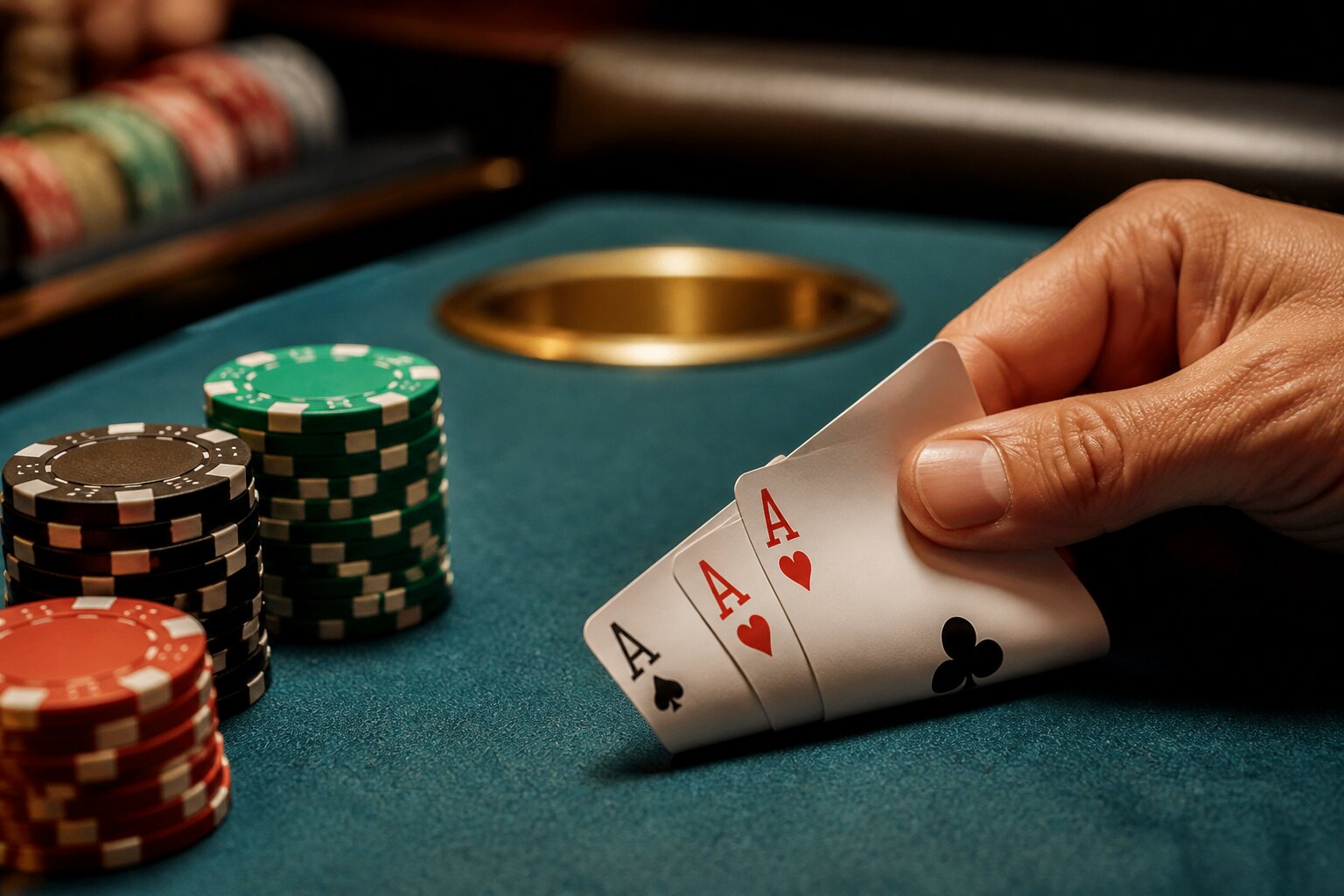
Looking to try something new at the casino? 3 Card Poker offers a brisk, card-based alternative to traditional table games that’s approachable for newcomers and satisfying for experienced players.
Its rules are compact and the rounds move quickly, so you’ll be involved in the action without a long learning curve. Read on to learn how the game works, which hands beat which, and the practical details that matter when you sit down to play.
What Is 3 Card Poker?
3 Card Poker is a table game where each player competes directly against the dealer using only three cards. Invented in the 1990s, it distils poker down to its essentials: hand rankings, betting choices and a head-to-head comparison at the end of the round.
Unlike five-card poker, there is no betting round among players; instead, the focus is on whether your three-card combination outperforms the dealer’s. This keeps each hand short and frequent, making the game well suited to busy casino floors and online play where pace matters.
If you want a quick sense of how a round unfolds, the next section walks through the typical table layout, the bets you’ll place and the decision you face once the cards are dealt.
How Does the Game Flow Work?
Each 3 Card Poker round follows a straightforward sequence: bets are placed, cards are dealt, players decide whether to continue, and then hands are compared. Because there are only a few choices each hand, newcomers can get comfortable quickly while still facing meaningful decisions about whether to fold or press on for a potential win.
Play moves at a steady pace, with each step clearly defined so players know what to expect. The structure also helps keep the game accessible while allowing for strategic thinking, such as weighing the odds of your three-card hand against the dealer’s potential holding.
Table Setup & Dealing Cards
The table clearly marks two primary wagering areas: Ante and Pair Plus. The dealer uses a standard 52-card deck and gives three face-down cards to each player and to themselves. Players assess their own three-card hand while the dealer’s cards remain concealed until the end of the round.
Seating and table limits vary by venue, so the dealer or floor staff will usually explain any local rules before play begins. Dealers follow a fixed dealing procedure and shoe or shuffle methods are applied according to the house rules to ensure fairness and consistency.
Placing Bets: Ante and Pair Plus
Before cards are dealt the Ante bet is placed to play against the dealer. Separately, Pair Plus is an optional bet that pays if the player’s three cards form a pair or better, irrespective of the dealer’s hand. Pair Plus outcomes are decided solely on the player’s cards, so it offers a different form of risk and reward to the head-to-head Ante play.
Stakes vary by table, so check the minimum and maximum before you sit down and choose amounts that fit your budget. It is also sensible to confirm any additional side bets or progressive jackpots that might be offered, as these can carry different payout structures and rules.
Playing the Hand: Fold or Continue
After viewing the three cards, a player can fold, surrendering the Ante, or place a Play bet equal to the Ante to continue. When the dealer’s hand is revealed, the comparison is made using the game’s hand rankings and the dealer’s qualification rule, typically a minimum rank such as Queen-high that the dealer must meet before claiming certain bets.
If the dealer does not qualify, different payout adjustments apply according to the house rules, so be sure you understand how non-qualification affects your Ante and Play bets. The following section explains those rankings in detail so you know what each hand is worth and how outcomes are determined.
Understanding 3 Card Poker Hand Rankings
Hand rankings in 3 Card Poker are adapted for three-card play, which changes the relative strength of combinations compared with five-card poker. Knowing these rankings helps you judge whether a Play bet is sensible and how side bets like Pair Plus might pay.
Below is the ranking from highest to lowest, with a short example for each:
Here are the official 3 Card Poker hand rankings, listed from highest to lowest, with examples for each:
Straight Flush: Three cards in sequence, all the same suit (e.g. 5♣ 6♣ 7♣)
Three of a Kind: Three cards of the same rank (e.g. Q♦ Q♥ Q♠)
Straight: Three cards in sequence, mixed suits (e.g. 3♣ 4♦ 5♠)
Flush: Three cards of the same suit, not in sequence (e.g. 2♠ 7♠ 10♠)
Pair: Two cards of the same rank (e.g. 8♦ 8♠ Q♥)
High Card: No combination; highest card determines rank (e.g. K♣ 9♦ 5♥)
Because there are fewer cards, straights and flushes occur with different frequencies than in five-card poker, which affects their relative value. The next section looks at how these rankings translate into the common payouts you’ll see on most tables.
Ante/Play Bet
When your hand beats the dealer and the dealer qualifies, Ante and Play bets normally pay even money (1 to 1). If the dealer does not qualify, the Play bet is usually returned and the Ante may be paid according to an Ante Bonus schedule that rewards stronger player hands.
Ante Bonus (often paid even if the dealer doesn’t qualify)
Strong hands can receive bonus payouts on the Ante regardless of the dealer’s qualification. Typical bonus examples are:
Straight Flush: 5 to 1 (e.g. £5 bet returns £25 profit)
Three of a Kind: 4 to 1 (e.g. £5 bet returns £20 profit)
Straight: 1 to 1 (e.g. £5 bet returns £5 profit)
These bonus payments are intended to reward high-ranking hands and can change the overall value of playing aggressively when you hold a promising three-card combination. Details vary by venue, so check the table paytable before wagering.
Pair Plus Bet
The Pair Plus bet pays if the player’s three cards form a pair or better, independent of the dealer’s hand. Standard payouts you may encounter are:
Straight Flush: 40 to 1
Three of a Kind: 30 to 1
Straight: 6 to 1
Flush: 4 to 1
Pair: 1 to 1
Because Pair Plus depends only on the player’s cards, it offers a different risk–reward profile compared with Ante/Play. The following section breaks down practical points—limits, common side bets and typical house edge figures—to help you weigh those options at the table.
Key Facts Every Player Should Know
A few practical facts help frame what to expect from 3 Card Poker: typical stakes, optional side wagers and how the house edge affects long-term play.
Minimum and Maximum Bets
Table limits vary by venue and platform. Minimum bets can be as low as £1 on some online tables and commonly start at around £5 in many casino rooms. Maximum bets range widely and can reach £100 or more on higher-limit tables. Knowing the posted limits helps choose a seat or game that matches your bankroll.
Side Bets and Bonus Options
Pair Plus is the common side bet, but some games offer additional features such as a 6 Card Bonus, where players and the dealer combine their three cards each to form the best five-card poker hand. Payouts for these extras depend on the paytable; for example, a full house on a 6 Card Bonus might pay 20 to 1 or better. Because these bets alter risk and reward, treating them as separate choices from the main game makes it easier to manage how much you stake overall.
The standard house edge for the Ante/Play combination is roughly 3.4%, while the Pair Plus house edge typically ranges from about 2% to 7% depending on exact payouts. Understanding these figures helps set realistic expectations about returns and variance.
Choose stake levels and side bets that match your goals and budget; the right mix keeps the game enjoyable and within planned limits. By combining a clear grasp of hand rankings, an eye for the table paytables and sensible stake management, players can make informed choices at the table.
This overview gives you the rules, the hand ranks and the practical facts needed to play 3 Card Poker confidently; armed with that information you’ll be ready to join a game and see how your decision-making plays out in each brisk round.
Play Casino Games at Thor Slots
A warm welcome awaits you at Thor Slots, where we invite you to explore a world of entertainment at your own pace. We're here to share the excitement of casino games with you in a relaxed and friendly setting.
Getting started is easy—just set up your account, make a deposit and you’ll be ready to play. We look forward to seeing you enjoy your time with us.
**The information provided in this blog is intended for educational purposes and should not be construed as betting advice or a guarantee of success. Always gamble responsibly.