
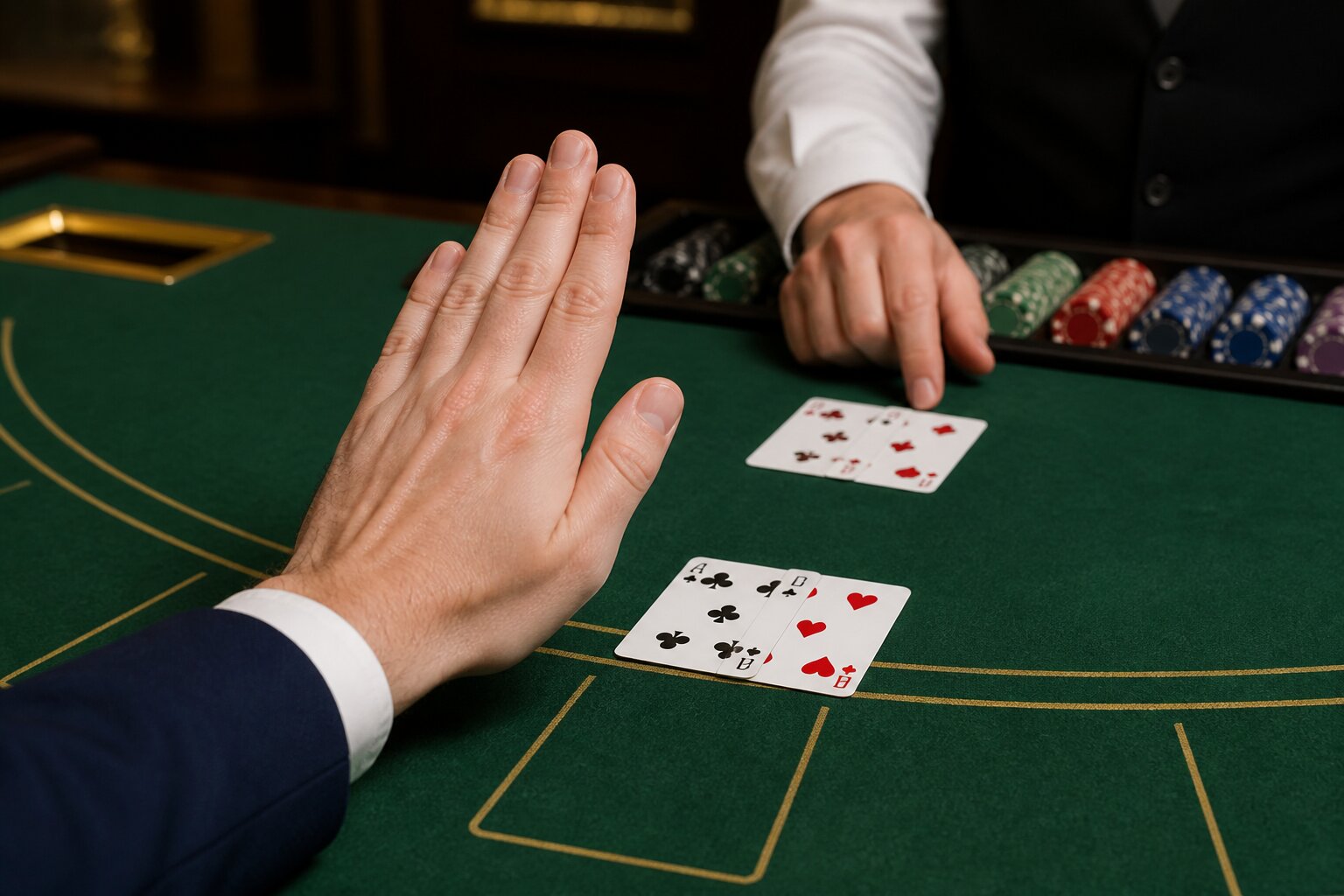
Ever found yourself at a blackjack table, cards in hand, and not quite sure what to do next? You’re not alone. “Stand” is one of the most important moves in the game, and knowing when to use it can make a real difference to how a hand plays out.
If you’ve ever wondered exactly what “stand” means, or struggled to decide when it’s the right time to use it, this guide will set out the meaning, the common situations where standing is sensible, and the dealer rules that affect the outcome. Read on to build a clearer sense of when to hold your cards and when it makes more sense to keep playing the hand.
What Does 'Stand' Mean in Blackjack?
In blackjack, to stand means the player keeps their current cards and ends their turn without taking any more. The decision signals to the dealer that the player is happy with their total and will not risk increasing it. From that moment the hand is fixed and the play moves on.
Standing is a deliberate choice among the standard options available each turn. Where hitting asks for an extra card, doubling down increases the bet for one final card, and splitting separates pairs into two hands, standing freezes the position and leaves the result to how the dealer completes their hand. This creates a clear boundary in the round: once a player stands, their fate is determined by the dealer’s subsequent play.
A practical example: holding a total of 19 is usually strong enough that most players will stand, since the chance of improving the hand without busting is small. That decision is about protecting a solid total rather than chasing an uncertain gain. With that in mind, the next section explains how standing compares with the other options at your disposal.
How Is Standing Different From Other Moves in Blackjack?
Standing differs from other moves because it ends the player’s involvement in that hand. Hitting continues the action by adding another card and increasing the hand’s value while raising the risk of going over 21. Doubling down enlarges the stake and obliges the player to take exactly one card before stopping. Splitting two like-valued cards creates two separate hands that are played independently, each with its own chances and risks.
Each action carries a different trade-off between risk and potential reward. Standing is the conservative choice: it accepts the current total and removes further uncertainty for that hand. Players often weigh how close they are to 21 against what the dealer shows and any house rules in play. Those elements together form the context for whether standing or another move best fits a particular situation.
Now that the options are clearer, the next section looks at how to decide when standing is the sensible call in practical play.
When Should You Stand in Blackjack?
Deciding to stand depends on several factors: the value of your hand, the dealer’s visible card, and the particular house rules. There is no single rule that fits every hand, but certain patterns are widely accepted because they reflect the mathematical balance between risk and reward in common situations.
Players typically stand on higher totals where the risk of busting outweighs the potential benefit of another card. For hands of 17 or higher, for example, standing is often the prudent choice. For lower totals, other factors—such as whether the hand is “soft” (containing an ace counted as 11) or “hard” (no ace counted as 11)—can change the calculation, because a soft hand has more flexibility if another card is drawn.
Your own approach to risk also matters. Some players prioritise preserving their stake and will stand earlier, while others accept more volatility in pursuit of larger wins. Practical awareness of limits and a steady bankroll approach helps shape sensible choices during a session. The next subsections explore typical standing scenarios and the main influences on that decision.
Common Scenarios for Standing
Common situations that lead players to stand include holding totals of 18, 19 or 20, where the likelihood of improving without busting is small. Soft totals such as an ace and six (often called soft 17) are more nuanced: some players stand while others hit, because the ace can be counted as 1 or 11, giving that hand additional flexibility.
The dealer’s upcard changes the inclination to stand. If the dealer shows a low card like 4, 5 or 6, they are in a vulnerable position and players may stand on slightly lower totals to capitalise on the dealer’s higher chance of drawing a bust. Conversely, a strong dealer upcard such as a 10 or ace often prompts players to be more aggressive in an attempt to improve their hand.
Rather than a rigid rulebook, these scenarios are practical guidelines that reflect the common balance of odds in play. With that context, it helps to consider the broader factors that influence the decision to stand.
Factors That Influence the Decision to Stand
Beyond your current total and the dealer’s upcard, several additional elements shape the standing decision. The number of decks in use affects card distributions and therefore the probabilities of certain outcomes. House rules—especially whether the dealer hits or stands on a soft 17—also shift the advantage slightly and can alter optimal choices.
Table limits, session bankroll, and a player’s tolerance for risk further influence whether standing is the right call in a given moment. Awareness of these variables helps a player make consistent, considered decisions rather than reacting on impulse. With the player’s choices set, it becomes important to know how the dealer will respond to those choices during the round.
Does the Dealer Have to Stand?
The dealer operates under fixed rules and does not make discretionary decisions. In most games, the dealer must stand on a total of 17 or higher. This rule may include both hard and soft 17s depending on the venue; some games require the dealer to hit on soft 17, which changes the sequence of play and the relative strength of the dealer’s hand.
Because the dealer follows a defined protocol, their actions are predictable and can be built into a player’s planning. That predictability is one reason players study common standing scenarios: knowing how the dealer will act lets a player better estimate whether their current total is likely to win. The following section explains what happens next once a player has chosen to stand.
What Happens After You Stand in Blackjack?
After standing, the player’s hand is final for that round. No further cards are dealt, and attention shifts to the other players and then to the dealer, who reveals their facedown card and completes their hand according to the house rules. The outcome for each player is determined when the dealer’s hand is compared to theirs: winning bets are paid, losing bets are collected, and pushes are returned.
This resolution phase is the moment the earlier decisions are tested against the dealer’s forced play. How the dealer draws can vindicate a cautious stand or expose a marginal total, but either way the round concludes and the table prepares for the next deal. With those mechanics in mind, it helps to clear up some common misunderstandings about standing.
Common Misconceptions About Standing
A common myth is that there is a single “correct” moment to stand that guarantees success. In practice, standing is one of several choices that balance probability and risk, and outcomes vary from hand to hand. Another misconception is that standing on a specific number, such as 16, always leads to losing if the dealer has a higher upcard; the final result depends on how the dealer finishes their hand and the particular rules in force.
Some players assume copying another person’s standing choices will produce the same results. While patterns and general principles can be followed, every hand is unique and should be judged on its own merits. Clear understanding of the rules, the dealer’s obligations, and how different hands behave gives a more reliable basis for decisions than relying on rigid maxims or imitation. Having considered these points, the concluding section ties the ideas together and notes a few practical reminders.
Final Thoughts on Standing in Blackjack
Standing is a core decision in blackjack that reflects a choice to protect a current total rather than risk further changes. Knowing what standing means, how it differs from hitting, doubling or splitting, and when it typically makes sense will make each round easier to read and play. Consider the dealer’s visible card, the composition of your hand, the house rules and your own risk tolerance when deciding whether to stand.
Play within your limits and make choices that fit your session plan. Only those aged 18 and over should gamble, and support is available for anyone worried about their relationship with gambling through organisations such as BeGambleAware. Use what you’ve learned here to make clear, informed decisions at the table and enjoy your play with a level-headed approach.
**The information provided in this blog is intended for educational purposes and should not be construed as betting advice or a guarantee of success. Always gamble responsibly.