
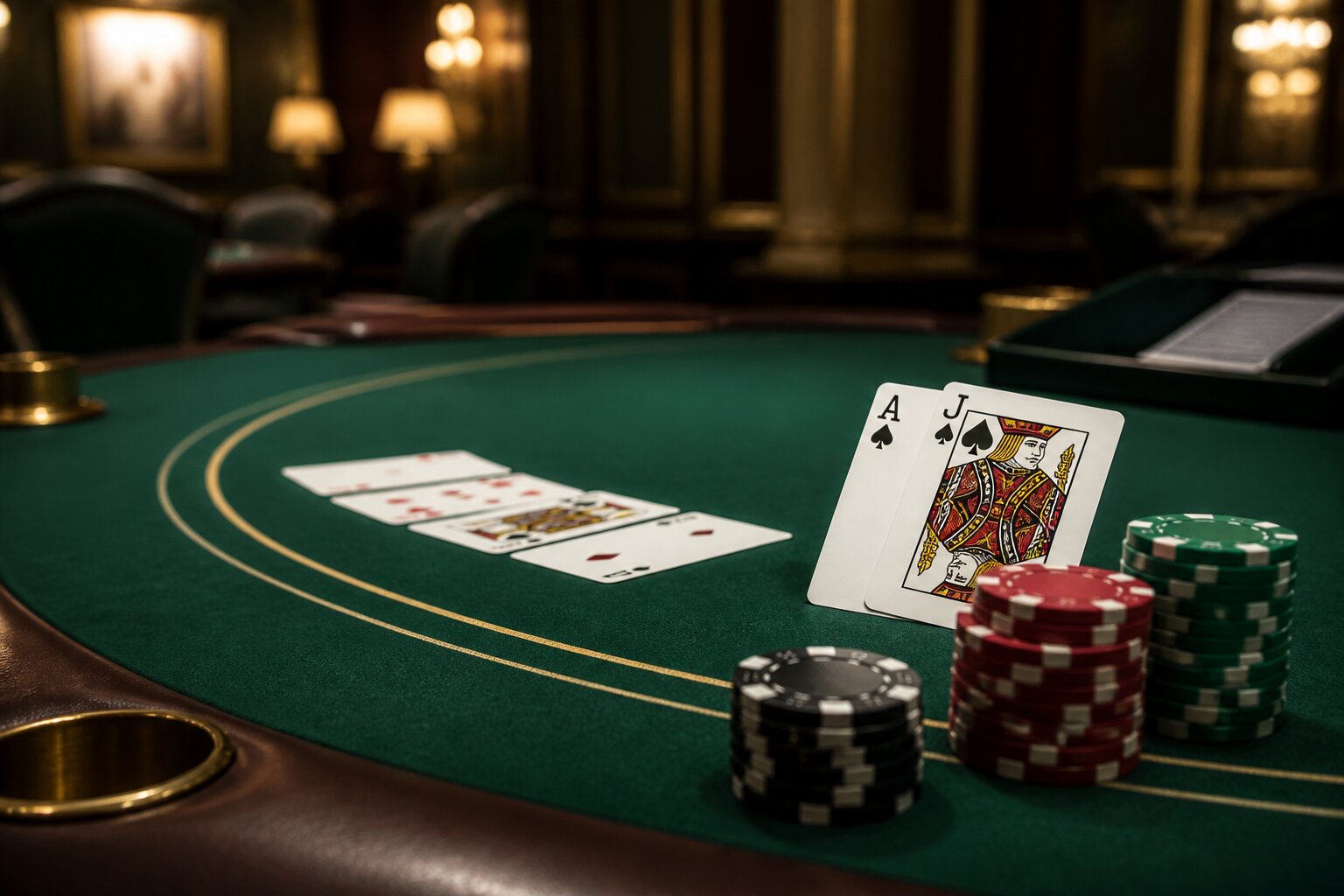
If you’ve ever walked past a casino table and wondered how blackjack works, you’re in the right place. This classic card game is simple to learn, yet there’s plenty to discover in every hand.
Whether you’re a complete beginner or want to brush up on the basics, this guide explains the game clearly — from card values and core rules to what happens around the table. We’ll begin with what blackjack is and why it continues to attract players.
What Is Blackjack & Why Is It So Popular?
Blackjack traces its roots back to seventeenth-century Europe where it was called “Twenty-One”. Over time it developed into the familiar modern form played across UK casinos and online sites.
The basic aim is direct: form a hand value as close to 21 as possible without exceeding it. Since players compete only against the dealer rather than against each other, the table usually has a social, low-conflict atmosphere.
A key part of its appeal is the balance between simple mechanics and meaningful decisions. Actions such as choosing whether to take another card or to stand give the game a layer of strategy without making it hard to learn. The clear, consistent rules used at regulated tables help new players feel comfortable and make choices with confidence. Next, the guide shows how that play is physically arranged at the table.
Blackjack Table Layout Explained
A standard blackjack table is often shaped like a half-moon, with the straight edge for the dealer and the curved side where up to seven players sit. Each player has a marked betting circle in front of their seat for placing chips before a round begins.
The dealer is positioned centrally behind the table with a chip tray and, where multiple decks are used, a card shoe nearby that holds the shuffled decks. Rules and payout information are usually printed near the betting area so players can check the table’s specific conditions at a glance. Minimum and maximum bets vary by table; smaller tables might accept stakes from a few pence up to higher limits on premium tables.
This layout gives every player a clear view of their own cards, their chips and the dealer’s actions, supporting smooth and transparent play. Understanding the physical set-up helps when it’s time to learn how card values work at the table.
Blackjack Card Values & Hand Rankings
Card values in blackjack are straightforward. Number cards (2–10) carry their face value. The face cards—Jack, Queen and King—are worth ten points each. Aces are flexible and count as either 1 or 11, whichever best suits the hand.
For example, an Ace plus a 6 can be counted as 7 or 17. If a further card would push the higher value over 21, the Ace is read as 1 to prevent a bust. The strongest possible opening hand is a “blackjack”: an Ace paired with any 10-point card. That 21 is paid more generously than ordinary wins.
If a hand exceeds 21 it’s a bust and that bet is lost. All hands are judged against a target of 21 and, ultimately, against the dealer’s final total. With card values clear, the next section outlines how those cards are put into play and how rounds unfold.
Understanding the Rules of Blackjack
A typical round begins with players placing bets in their betting circles. After staking, the dealer deals two cards to each player and two to themselves, usually with players’ cards face up and the dealer showing one card face up and one face down.
Play proceeds around the table, each player making decisions in turn. Options commonly available include asking for another card to improve a hand, staying with the current total, splitting a pair into two hands when the first two cards match in value, or doubling the original wager and taking just one more card. Specifics — such as whether splitting after certain hands is allowed or which totals the dealer must hit or stand on — are set by the table rules and displayed nearby.
A blackjack (an Ace and a 10-point card) is typically paid at 3:2, while ordinary wins pay even money. If both player and dealer have the same total (other than blackjack), the round is a push and the stake is returned. When the dealer’s face-up card is an Ace, some tables offer a separate insurance bet against the dealer having a blackjack; this side option pays if the dealer’s hidden card completes their 21. With the rules in place, the next part describes how the cards are dealt and revealed during a round.
How Does the Dealing Process Work?
Once bets are placed, the cards are shuffled and dealt in sequence. Where multiple decks are used, they are usually shuffled together and placed in a shoe for the dealer to draw from. Casino and regulated tables follow specific shuffle and cut procedures to reduce predictability and maintain fairness.
Dealing starts with the player furthest to the dealer’s left and continues clockwise so each player receives two cards; the dealer takes two as well, typically with one card face up and one face down (the hole card). The face-up card gives visible information to players, while the hole card remains hidden until the appropriate point in the round.
Players then act on their hands in turn, making choices informed by their own cards and the dealer’s visible card. Actions are taken in sequence so each player’s decision does not influence the cards remaining for others during that round. After every player has finished, the dealer reveals the hole card and completes their hand according to the table’s rules, drawing or standing on specified totals.
The dealer follows a fixed set of rules that dictate whether to draw or stand, commonly based on the dealer’s total and whether they must hit or stand on soft totals. These procedures and visible actions are designed to keep the round transparent and predictable for all participants. With the cards dealt, players choose between several possible actions — the next section explains those options and how they affect play.
Hit, Stand, Split & Double Down
When a player’s turn arrives there are a handful of standard decisions available, each changing how the rest of the round plays out. The options carry different levels of risk and potential reward, and players often consider both their own hand and the dealer’s visible card when deciding.
Hit
A hit is a request for an additional card to improve a hand’s total. It is often considered when a player feels their current total is too low to beat the dealer’s likely return. Players can take multiple hits in turn until they either stand or their total exceeds 21.
Stand
Standing means keeping the current hand and taking no further cards. Players stand when they are satisfied with their total and prefer not to risk going over 21. Choosing to stand ends that player’s action for the round and leaves the dealer to complete their hand.
Split
If the first two cards are the same value, they can be separated into two hands, each with its own stake equal to the original bet. Splitting gives the chance to play two independent hands when the starting pair presents a particularly advantageous situation. Each split hand is then played separately, and some tables allow re-splitting under certain conditions.
Double Down
Doubling down involves increasing the wager to twice the original stake and receiving exactly one more card. This move is used when the player judges a single extra card has a strong chance of producing a competitive total. It shortens the round for that hand, since no further hits are permitted after doubling down.
Surrender & Insurance: What Do They Mean?
Surrender
On some tables a surrender option is offered after the initial deal, allowing the player to forfeit the hand in exchange for a partial return of their stake. This can limit losses in situations where the dealer shows a strong card and the player’s hand has poor prospects. Not all venues offer surrender, and the exact payout for surrender can vary by table.
Insurance
Insurance is a side bet available when the dealer’s face-up card is an Ace. It pays out if the dealer’s hidden card completes a blackjack, but it is separate from the main wager and does not alter the odds for the player’s primary hand. Because it is a distinct bet, players weigh the insurance amount against the likelihood of the dealer having a 10-point card underneath the Ace.
Each of these options changes the risk and reward balance at the table, and choosing between them depends on the hand, the dealer’s visible card and the table rules. Players are advised to familiarise themselves with house rules before play, since those rules affect when and how each option may be used. After actions are completed, outcomes are determined — the following section explains how winners are settled.
How Are Winners Determined in Blackjack?
Once all players have finished their turns and the dealer has completed theirs, each player’s final total is compared to the dealer’s. A hand that is closer to 21 than the dealer’s without exceeding 21 wins and pays out at the table rate. Equal totals result in a push, returning the player’s stake.
If a player’s hand goes over 21, it is a bust and the bet is lost immediately. A dealer bust benefits any player who remains under 21. Blackjack hands are treated specially: an Ace with a 10-point card normally pays at a higher rate and beats any non-blackjack total.
Outcomes are resolved according to the table’s published rules so players can see how payouts and pushes are handled. With winners decided, the social norms around the table help keep play orderly and pleasant — the next section looks at etiquette that supports a good experience for everyone.
Essential Blackjack Table Etiquette
Polite behaviour and clear signals make the game smoother for everyone. It is common practice to take a seat and wait for a round to end before placing a bet, and to place chips inside the marked betting circle prior to the deal so the dealer can identify stakes easily. In venues where players handle cards, rules about touching cards are displayed and followed to protect the integrity of the game.
Decisions are usually indicated by straightforward gestures as well as spoken words, for clarity. Players normally avoid advising others during a hand or discussing active plays, and keep conversation and movements unobtrusive so the dealer and other players can concentrate. When playing via a live online table, on-screen prompts guide betting and actions while courteous, concise chat is preferred.
Following these conventions supports a fair and enjoyable table atmosphere for everyone. If you plan to play, choose a table with limits that suit your budget and be mindful of your stakes; the rules and etiquette together help ensure each round is clear and well managed. This completes the essentials of playing blackjack, giving a full picture of what to expect at the table and how to take part with confidence.
Enjoy Casino Games at Thor Slots
We welcome you to explore our site and enjoy a relaxed gaming experience among friends. Whether you’re new to casino games or just looking to unwind, you’re always invited to play at your leisure.
Getting started is straightforward—just set up your account, make a deposit, and you’ll be ready to play. We look forward to seeing you enjoy your time at Thor Slots.
**The information provided in this blog is intended for educational purposes and should not be construed as betting advice or a guarantee of success. Always gamble responsibly.