
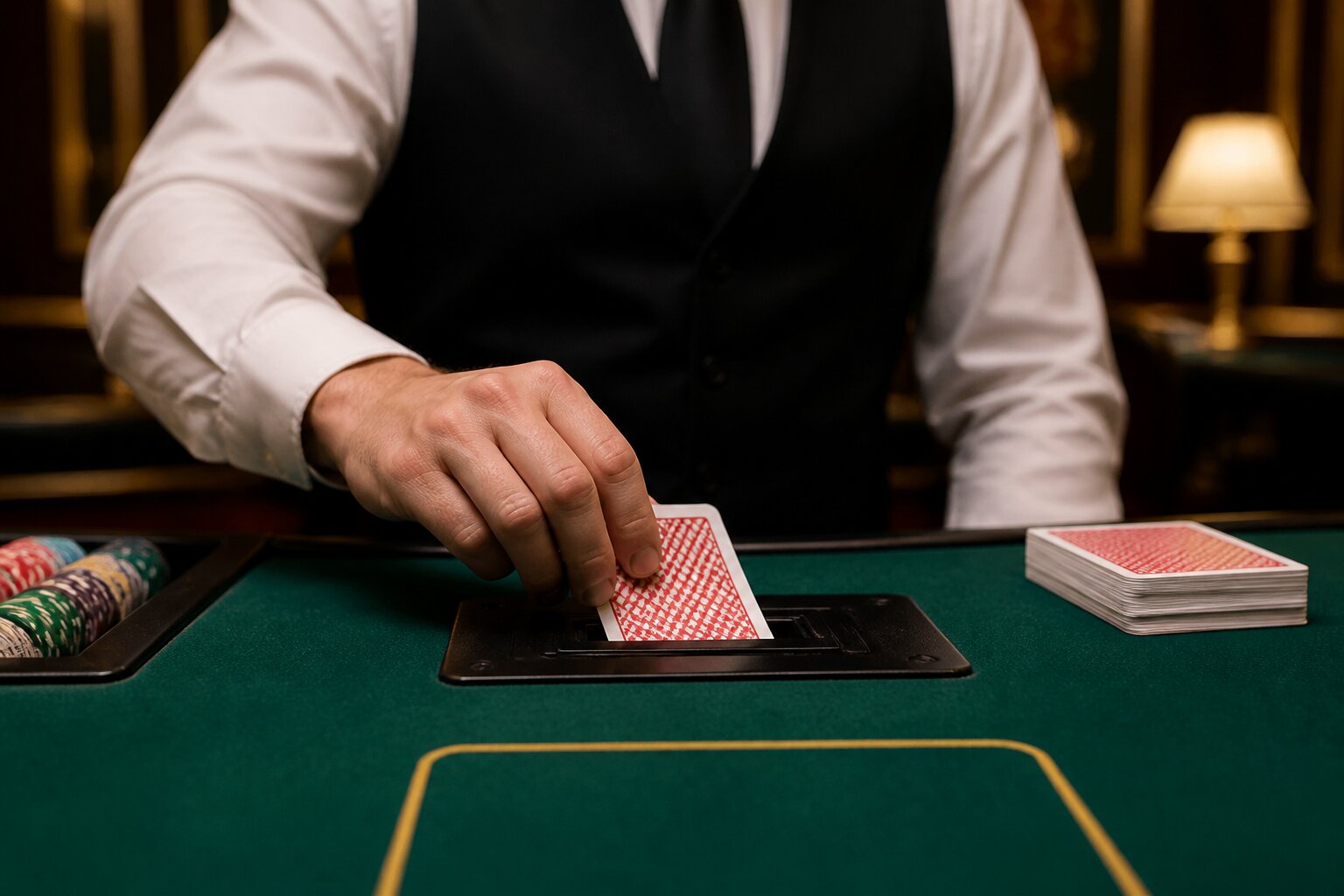
You settle at the table, chips in hand, and watch the dealer take a card from the freshly shuffled deck and slide it face-down into the discard pile before the first hand is even dealt. That small, quiet action—burning a card—repeats at tables the world over and in live dealer streams, yet it often goes unnoticed. There’s a practical reason behind the ritual, and it helps explain a few other standard procedures you’ll see at the table.
If that little gesture has ever made you curious, this article walks through what burning cards means, how it’s done, why casinos do it and how much effect it actually has on play. Read on to see how this simple step fits into the broader aim of keeping play straightforward and predictable for everyone.
The Meaning of Burning Cards in Blackjack
Burning cards in blackjack means removing one or more of the top cards from a freshly shuffled deck or shoe, face-down, before play begins. Those cards are placed in the discard pile and are not revealed or used for that shoe. The practice usually happens just after a shuffle and the cut, and it applies whether the table uses a single deck or a multi-deck shoe.
Typically only one card is burned, though some venues or specific house rules call for more. The dealer performs the action quietly and according to procedure so that no player gains information about the card order. This small step sets the stage for the first deal and reduces the chance of any visible card being used to gain an advantage. Now that you know what a burn is, the next section explains exactly how dealers carry out the process at the table.
How Does the Burn Card Process Work?
After shuffle and cut, the dealer gathers the deck or shoe, then takes the top card and places it face-down on the discard pile. That card is never shown and is out of play for the remainder of the shoe. In multi-deck games the same sequence applies, though the decks are dealt from a shoe rather than by hand; in single- or double-deck tables the dealer follows the same steps while handling the smaller pack.
The routine is usually performed only once at the start of a fresh shoe. If the shoe runs out and a reshuffle is required, the procedure may be repeated when the new shoe is prepared. Continuous shuffling machines, which mix cards continuously, remove the usual need for a distinct burn because there is no single top card to set aside. With that distinction in mind, the next section looks at why casinos adopt this practice at all.
When Are Burn Cards Used During the Game?
Burn cards are used at the beginning of a new shoe or freshly shuffled deck and occasionally again after a mid-shoe reshuffle. Dealers do not burn a card between ordinary rounds once play has started.
Are Burn Cards Always Drawn from a New Deck?
Yes—burn cards are taken from newly shuffled or newly opened packs. The aim is to remove any chance that the first visible cards after a shuffle might have been exposed during handling.
What Purpose Does Burning Cards Serve?
The core purpose of burning cards is to protect the integrity of the game by removing any possibility that the first card or cards after a shuffle have been seen or otherwise exposed. When a pack is cut and handled, the new top card can be more visible than others; removing it face-down prevents anyone from capitalising on that information.
This measure reduces the risk of simple card-tracking or sleight-of-hand methods that focus on the immediate post-shuffle order. It is one element among several designed to ensure play remains fair and that no participant has knowledge others do not. While burning can’t stop every form of advantage play, it eliminates an obvious and easily exploited opportunity. With that foundation in place, it’s worth considering how effective burning is against more sophisticated approaches such as card counting and cheating.
Does Burning Cards Prevent Cheating or Card Counting?
Burning cards closes off specific avenues for cheating: it removes the immediate top card that might have been exposed during the cut, and it reduces the chance of a dealer or player using a glimpse of that card to influence play. However, it is not a universal defence. Card counting depends on tracking the overall distribution of high and low cards as rounds progress, so the loss of one or two unseen cards to a burn has only a minor effect on those calculations in most games.
For preventing deliberate cheating—marked cards, collusion or sleight of hand—burning is one of several procedural safeguards. Others include thorough shuffling, table surveillance, visible shoe handling, and clear dealing protocol. Together these measures make it far harder to exploit the system, though no single procedure can claim absolute protection. Understanding these limits helps explain why casinos use a bundle of overlapping practices rather than relying on one alone. The following section explores how the exact approach to burning can differ by venue and game type.
Differences Between Casinos and Blackjack Variants
The principle behind burning is consistent, but implementation can vary. Some casinos burn only one card; others may specify two or more in certain games or private settings. Single-deck tables, multi-deck shoe games and live dealer streams all mirror the same basic routine, but handling and visibility differ with the format.
Continuous shuffling machines generally remove the need for a conventional burn because the cards are mixed continuously. Meanwhile, random number generator (RNG) versions of online blackjack may automate any equivalent step within the software so the outcome mirrors real-world procedures without the physical action. House rules, table signage and local procedures determine the precise sequence, and these small variations reflect operational differences rather than a change in intent. Myths and misunderstandings sometimes spring from those differences, so the next section separates fact from fiction.
Common Myths About Burn Cards
Players often worry that burning cards is a gimmick intended to worsen their chances, or that casinos discard high-value cards to frustrate counters. In truth, burning is a neutral action: the card or cards removed are random and unknown to all parties, so they do not intentionally disadvantage players.
Other misconceptions include the idea that burning significantly alters odds. Removing one or two unseen cards has negligible impact on the statistical balance of a shoe in practical play. Another mistaken belief is that burning happens only in physical casinos; live dealer games reproduce this step to reflect table procedures, while RNG tables may handle it invisibly in code.
Rules vary by operator and game type: some venues burn one card, others more; live dealer streams will follow visible protocol, whereas RNG systems may not show any physical burn. These differences explain why the practice can seem inconsistent even though the purpose remains the same. With misunderstandings cleared up, you should now have a clear sense of what burning achieves and how it fits into the wider set of safeguards that keep blackjack straightforward and fair.
Play Online Casino Games at Thor Slots
We would love to welcome you to Thor Slots, where we are all about making your online casino experience enjoyable and entertaining. Explore a site where everything is designed to help you have a great time.
Getting started could not be simpler, as you just need to create an account, make a deposit and you are ready to play. We look forward to seeing you join us and have fun with our friendly community.
**The information provided in this blog is intended for educational purposes and should not be construed as betting advice or a guarantee of success. Always gamble responsibly.