
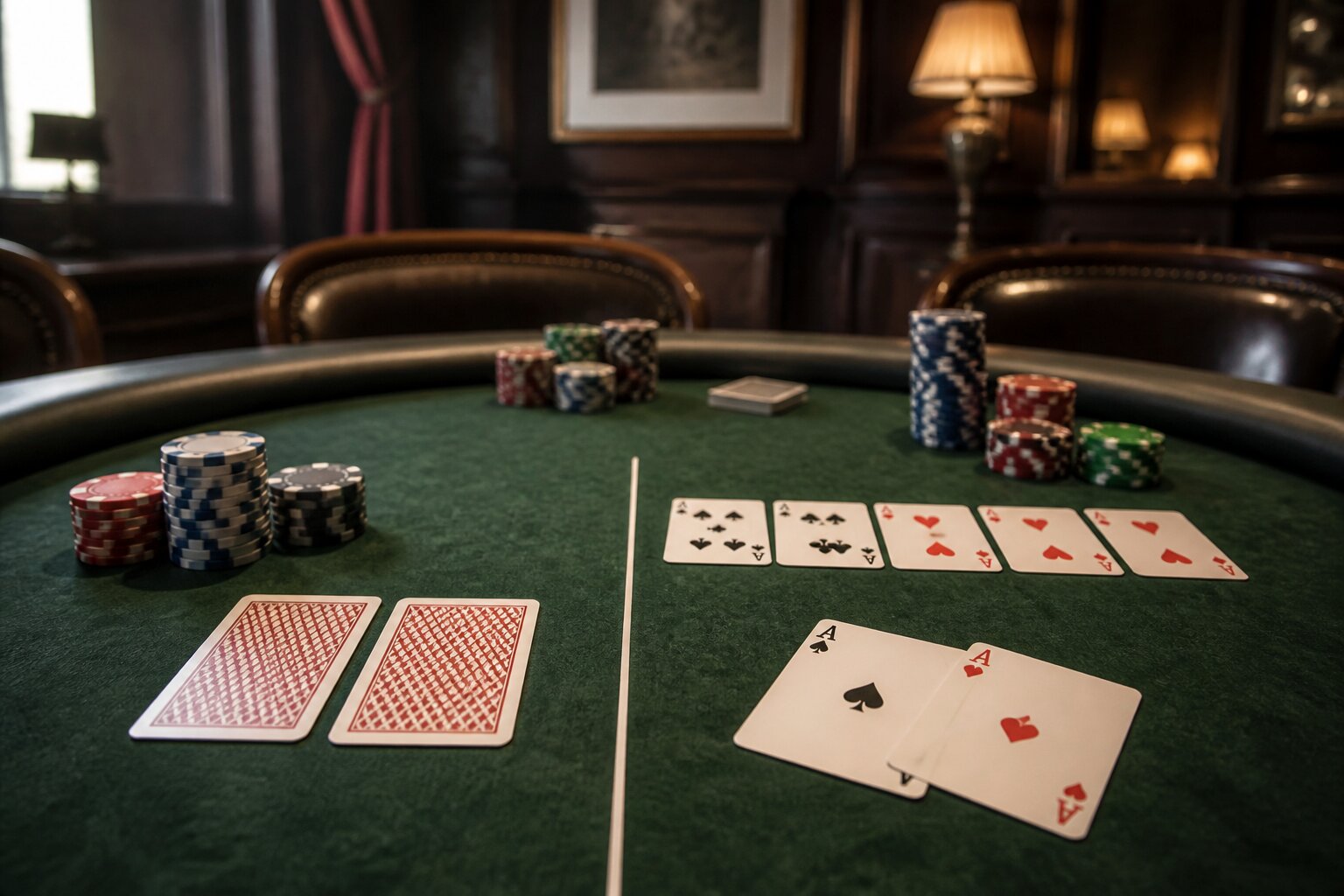
Ever found yourself sat at the pub or browsing an online casino, wondering why Texas Hold’em tables seem so popular compared to other forms of poker? Or perhaps you’ve heard someone talk about playing “regular poker” and wondered what makes it different from all the Hold’em action you see on telly.
You’re definitely not alone. Poker comes in many forms, and Texas Hold’em is only one of them. A clear sense of the rules and some example hands will make it easier to choose which game suits you and to follow the action at the table.
Next we’ll look at what people usually mean by “regular poker” and how those older variants work.
Understanding Poker: What Is ‘Regular Poker’?
‘Regular poker’ is a loose term in the UK, typically referring to the traditional games that existed before Texas Hold’em rose to prominence. The two most common variants implied by the phrase are Five Card Draw and Seven Card Stud.
Five Card Draw is the classic home-game style: each player receives five private cards, concealed from others. After an initial betting round there’s a draw phase, where players can exchange some cards from the deck to try to improve their hand. A final betting round follows, then players reveal their hands and the best five-card combination wins the pot.
Seven Card Stud is more structured and gives players additional visible information. Over several rounds each player receives a mix of face-down and face-up cards, without any drawing phase. Players build their best five-card hand from the seven cards they end up holding, and the exposed cards let you make educated guesses about opponents’ ranges.
Both of these games use the standard poker hand rankings and rely on private hands rather than a shared board. The next section turns to Texas Hold’em to show how its shared-card design changes the table dynamics.
Texas Hold’em Explained: Basics & Main Features
Texas Hold’em is widely played because its combination of private hole cards and community cards creates frequent decision points and visible drama. Each player is dealt two private cards, called hole cards. The centre of the table then receives up to five community cards in stages: three on the flop, one on the turn, and one on the river.
Play begins with a betting round after the hole cards are dealt. The flop follows, then another betting round, then the turn and its betting round, and finally the river and the last round of betting. Forced bets—Blinds (small and big)—start the action and rotate around the table, ensuring there is always something to play for each hand.
To form a hand you combine your two hole cards with the five community cards, choosing the best five-card combination available. For example, holding an ace and king while three aces appear on the board would give you four of a kind. The visible community cards create opportunities for strategy based on position, bet sizing and reading opponents’ likely holdings, while the private hole cards keep information asymmetric and interesting.
With that in mind, the next section compares the specific rule differences and betting patterns between Hold’em and classic variants.
Comparing Rules: How Do Gameplay and Betting Differ?
Texas Hold’em and regular poker variants like Five Card Draw share the same hand rankings, but the mechanics of play and betting structure shape very different experiences.
Card Dealing and Gameplay
Texas Hold’em: Each player receives two hidden hole cards. Five shared community cards are revealed in stages, and players make the best five-card hand from any combination of their two cards and the five on the board.
Five Card Draw: Players get five private cards, all face down. There are no community cards; instead players may discard and draw replacements once, aiming to improve their hand before the final showdown.
Betting Rounds and Structure
Texas Hold’em: There are four betting rounds—pre-flop, post-flop, after the turn, and after the river. Blinds (small and big) are used to create initial stakes and rotate, affecting positional strategy.
Five Card Draw: Typically features two main betting rounds: one after the deal and another after the draw. Traditional home games often use an ante rather than blinds, which produces a different pattern of aggression and pot-building.
Betting Example
In Texas Hold’em, early betting often happens before any community cards are visible because the blinds have already committed chips to the pot. As community cards appear, players adjust their actions according to the evolving board and their position.
In Five Card Draw, the first betting round is informed only by players’ private cards; the draw then changes hand strengths and leads into a final betting phase with less shared information to interpret.
These structural differences make Hold’em more about extracting value from communal information and position, while Draw games put emphasis on concealment and timing.
Regardless of format, manage stakes sensibly: only risk amounts you can afford to lose and keep play within personal limits.
Typical Hands: Example Scenarios in Each Game
Texas Hold’em Example
Imagine you are dealt the Ace of Hearts and King of Diamonds as your hole cards. The flop is Ace of Spades, Ten of Hearts and Four of Clubs, giving you a pair of Aces. The turn brings the King of Spades, upgrading you to two pair: Aces and Kings. The river is the Three of Diamonds. Your best five-card hand is two pair (Aces and Kings) with a Ten kicker.
At showdown an opponent reveals Ace of Clubs and Queen of Diamonds, which makes them a single pair of Aces with a Queen kicker. Your two pair beats that, so you take the pot.
Five Card Draw Example
You receive Ten of Hearts, Ten of Spades, Seven of Clubs, Queen of Diamonds and Four of Hearts. After betting you discard the Seven, Queen and Four and draw three new cards: Ten of Diamonds, Five of Clubs and Jack of Hearts. Your final hand is three Tens, with a Jack and Five as kickers.
At the showdown, any player holding three Jacks or better would beat your set of Tens; otherwise your three-of-a-kind wins the pot.
These examples illustrate how the same hand rankings apply but how the path to those hands differs sharply between the two formats. Next we’ll look at how those paths influence player experience and strategy.
Key Differences: Player Experience & Strategy
The presence of community cards in Texas Hold’em shifts the on-table dynamics. Position becomes a major strategic tool because acting later reveals more information about other players’ choices. Betting behaviour can be used to represent particular holdings on the board, which makes bluffing and semi-bluffing part of a broader tactical palette. Players often think in terms of ranges—groups of hands an opponent might hold given the visible cards and their betting pattern.
In contrast, games where every card is private, such as Five Card Draw or Seven Card Stud, put a greater premium on reading opponents’ behaviour and betting patterns, plus careful memory of exposed cards in stud formats. Bluffing in draw games tends to be based on betting timing and the number of cards exchanged, rather than a shared community board. Each format rewards a different mix of observational skill and mathematical judgement.
Both styles call for knowledge of hand strengths, appropriate bet sizing, and attention to opponents’ tendencies. No amount of strategy changes which cards are dealt, so adaptability and measured decision-making remain central to strong play.
Popular Variations of Poker Compared
Beyond Texas Hold’em and Five Card Draw, several other variants are commonly played and each changes the flavour of the game by altering how much information is private or public.
Other Community Card Games
Omaha Hold’em
In Omaha, players receive four private cards and must use exactly two of them along with three of the five community cards to make their best hand. That exact-two rule creates many more possible hand combinations and typically results in larger pots and more multi-way action.
Draw & Stud Poker Variants
Seven Card Stud
Players receive seven cards across the hand—three face down and four face up—without any community cards. The exposed cards give partial information each round and reward attention to what others are showing.
Five Card Draw
A compact format where each player is dealt five cards and can exchange some of them once. With just two betting rounds, the game emphasises timing, confidence and careful interpretation of who chose to draw or stand pat.
Five Card Stud
Each player gets one card face down and four face up over a series of betting rounds. The exposed cards shape betting decisions more directly than in Seven Card Stud, because less information is hidden.
These variants demonstrate how changing the mix of private and public information alters both tactics and pace. Whether a table prefers the visible drama of community cards or the concealment of draw and stud games, there’s a style to suit different tastes.
Play Online Casino Games at Thor Slots
We would love to welcome you to our site to experience all the fun and excitement we have to offer. Take a seat and enjoy the buzzing atmosphere we have created for our community.
Getting started is easy: create an account, make a deposit and you are ready to play whenever you feel like it. We look forward to having you with us for some great entertainment.
**The information provided in this blog is intended for educational purposes and should not be construed as betting advice or a guarantee of success. Always gamble responsibly.