Blackjack is full of small decisions that shape each hand, and soft 17 is one of the most talked-about. It looks simple, yet it affects how both players and dealers act.
You will see the term in table rules and hear it in strategy conversations. This guide explains what a soft 17 is, how it differs from a hard 17, why dealers sometimes take another card, and how players tend to respond in common situations.
Whether you are new or refreshing your knowledge, understanding soft 17 helps turn a tricky spot into a clearer, more confident choice. Always play within your means.
What Is A Soft 17?
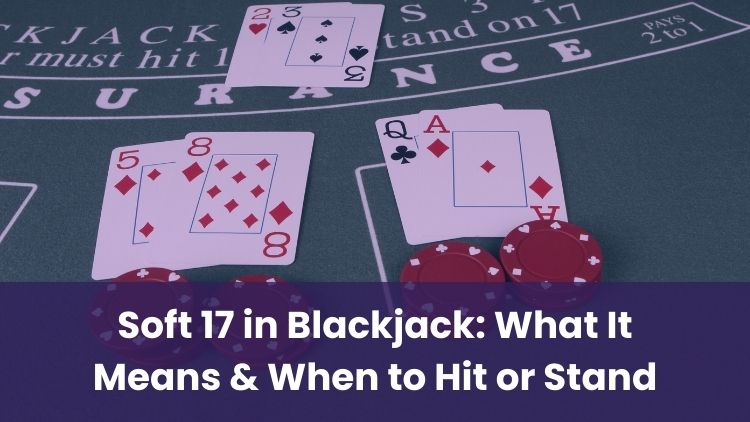
A soft 17 in blackjack is any hand totalling 17 where one card is an Ace counted as 11. The hand is “soft” because the Ace can also be counted as 1 if needed.
For example, Ace and 6 is a soft 17. It can play as 17 with the Ace counted as 11, or drop to 7 if the Ace switches to 1 after another card is drawn.
This flexibility means a player can take another card without automatically going over 21. That safety net is what sets it apart and is the reason soft hands are handled differently from other totals.
How Does Soft 17 Differ From Hard 17?
A soft 17 keeps its flexibility because the Ace can still be valued at 11 or 1. By contrast, a hard 17 has no such give. It is either made with no Ace at all, or with an Ace that already counts as 1 because using 11 would exceed 21. Hands like 10 and 7, or Ace, 3, 3, are both hard 17.
Why it matters is straightforward: with a soft 17, taking another card is less risky because the Ace can drop to 1 and keep the hand in play. With a hard 17, any extra card can easily push the total above 21.
Why Do Dealers Sometimes Hit Soft 17?
Many tables specify that the dealer must take another card on soft 17. You will see this shown as “Dealer hits soft 17” or “H17.” Other tables say “Dealer stands on soft 17” or “S17.”
When the dealer hits soft 17, the house gains a slight edge because that extra card sometimes turns a weak 17 into a stronger total like 18 or 19. If the dealer stands on soft 17 instead, player outcomes tend to be a little better over time.
It is worth checking the table layout before you sit down. Knowing whether it is H17 or S17 can influence how you approach certain hands. With that in mind, how should a player handle their own soft 17?
When Should You Hit Or Stand On A Soft 17?
The best move with a soft 17 usually depends on the dealer’s upcard and the table rules. Because the Ace gives a safety buffer, many players choose to take another card and try to improve the total.
Against a strong dealer card such as 7, 8, 9, 10, or Ace, hitting is commonly recommended. A soft 17 rarely holds up against those upcards, and drawing can turn it into a more competitive hand.
Against weaker upcards like 3, 4, 5, or 6, basic strategy in many rule sets suggests doubling down with Ace and 6 if the game allows it. Against a dealer 2, some charts still prefer a double, while others advise a simple hit, so it is worth checking the version that matches your table rules.
Standing on a soft 17 is unusual because the hand can often be improved at low risk. If in doubt, a basic strategy chart tailored to the specific game rules is a reliable reference. These choices also interact with the dealer’s rule on soft 17, which affects the house edge.
Dealer Rules And House Edge For Soft 17
Tables make the soft 17 rule clear on the felt: either H17 or S17. If the dealer must hit soft 17, the house edge typically increases slightly, often by around a couple of tenths of a percentage point compared with standing on soft 17. Over a single hand, you may not notice much, but across many hands, it can add up.
Players who prefer marginally better odds may choose S17 tables when available. If the choice is between H17 and S17 with otherwise similar rules, knowing the difference helps you pick the game that suits your approach.
Let’s put this into practice with the most common soft 17 scenario.
Common Soft 17 Hands And What To Do
Players most often face soft 17 as Ace and 6. The right move depends on what the dealer shows and whether doubling is permitted by the table rules.
Ace-6 Versus Dealer 2 To 6
Basic strategy commonly recommends doubling down against dealer 3, 4, 5, or 6 if the option is available, as these upcards are more vulnerable and the extra stake can be justified by the potential to improve. Against a dealer 2, the advice can vary by rule set, with some charts favouring a double and others a hit.
If doubling is not allowed, taking another card is the usual choice. Standing is rarely preferred here because Ace and 6 can often be strengthened safely.
Ace-6 Versus Dealer 7 To Ace
When the dealer shows 7, 8, 9, 10, or Ace, hitting is generally the best approach. Doubling down is not typically advised in these matchups, as the dealer’s high card pressures weaker totals and you benefit more from the chance to build a better hand.
How To Apply This At The Table
Putting this into practice starts with recognising a soft 17 and noting the dealer’s upcard. From there, the table rule on soft 17 matters, so check whether the dealer hits or stands before you play. Many players also keep a basic strategy chart for the exact rule set, which helps keep decisions consistent.
Choose tables with rules you are comfortable with, set sensible limits, and keep play occasional. If gambling begins to affect your finances or well-being, seek support early. Independent organisations such as GamCare and GambleAware provide free, confidential help.
**The information provided in this blog is intended for educational purposes and should not be construed as betting advice or a guarantee of success. Always gamble responsibly.