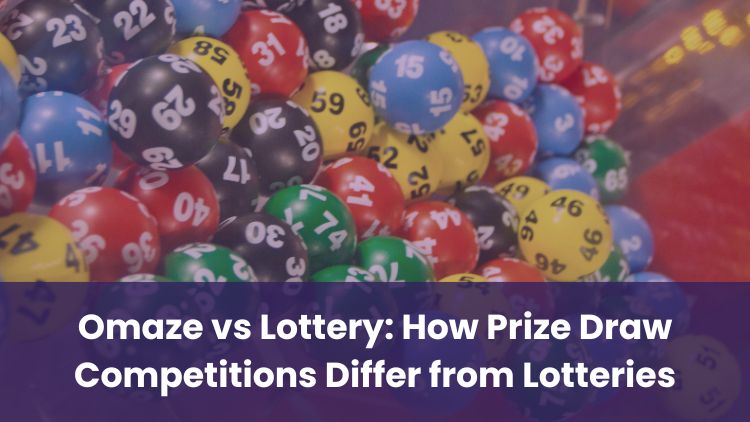
The world of competitions and lotteries is not as straightforward as it might seem. You might scroll past adverts for luxury house giveaways or see charity prize draws online and assume they work like buying a lottery ticket, but each follows its own rules.
Knowing the difference between a competition like Omaze and your local lottery makes everything clearer if you are considering taking part. This matters more than ever as prize draws become more visible across the UK.
In this article, you will find out how prize draws and lotteries are set up, what makes them distinct under UK law, and why they run the way they do. We will untangle what separates the two so you know exactly what you are entering before you decide.
What Is a Prize Draw Competition and How Does It Work?
A prize draw competition is a promotion where entrants have the chance to win something, such as a car, house or cash, through a random draw. Businesses and charities use them to raise funds or raise awareness.
Entry is often available for a fee, but a key feature is that there is usually a free route as well, for example by posting an entry or completing an online form. That free method keeps the promotion outside strict lottery rules because payment is not the only way in.
A winner is chosen at random, typically using verified software or a certified process to ensure fairness. The terms and conditions should set out how the draw is run, how many prizes there are, any closing dates, and what counts as a valid entry.
Under UK law, prize draws are distinct from lotteries because you do not have to pay to enter, or if payment is accepted, a free entry route must be offered on a no less favourable basis. Reputable operators make this clear and explain how to use the free route.
If you come across a competition that interests you, check the rules so you understand how entry works and what the prize includes. With that in mind, how does this differ from a lottery where payment is part of the model?
What Is a Lottery and How Does It Differ Mechanically?
A lottery is a game where you pay to enter for the chance to win a prize. In the UK, this includes the National Lottery as well as society lotteries and some raffles.
Participants buy tickets, either online or at retail outlets, and all paid entries go into a draw. Winners are selected at random, for example by numbered balls or a digital system. Unlike prize draws, entry involves payment, there is no free route.
Lotteries must comply with Gambling Commission rules. Operators need a licence or registration, and there are clear requirements for how ticket revenue is allocated. A set proportion goes to good causes, with the remainder used for prizes and operating costs.
Mechanically, lotteries are games of chance. There is no qualifying question or task, and outcomes are determined by the draw. That regulatory framework explains why entry methods and costs look different in practice.
How Do Entry Methods and Costs Compare?
For UK lotteries, each entry is paid. A National Lottery ticket, for instance, has a set price per line and that price applies whether you buy online or in a shop.
Prize draw competitions tend to be more flexible. Many sell entries in different quantities, sometimes with bundled pricing for multiple entries, especially when higher value prizes are on offer. Crucially, they often offer a free entry route as well. In law, that free method must be no less favourable than the paid route, which means it should be clearly explained and processed on the same basis as paid entries.
Costs can vary significantly from one promotion to another. Before entering, review the rules, pricing, and any closing dates so you know what you are committing to and how your entry will be handled.
Prize Types and How Winners Are Paid
Lotteries usually focus on cash prizes. These range from small, fixed amounts to very large jackpots. Once a win is verified, cash is normally paid by bank transfer. For smaller amounts on instant win games, the retailer may settle in store if the ticket was bought there, subject to their limits.
Prize draw competitions often offer a wider mix of rewards. Alongside cash, you might see houses, cars, technology bundles, holidays, or prize packages that combine several items. Where the prize is property, organisers typically cover the legal transfer and help coordinate practical steps such as completion.
If a non cash prize is awarded, the winner is contacted to arrange delivery or handover. For high value items, identity checks and paperwork are common. Cash prizes from draws are usually paid by bank transfer or cheque. Good operators explain any conditions attached to a prize, such as insurance, service charges, or restrictions on transferring the prize to someone else.
How Are Odds and Prize Probabilities Calculated?
Odds describe the probability of winning. In number based lotteries, the calculation depends on the range of numbers and how many must match. With millions of possible combinations, the probability of a top prize is typically very small, while smaller prizes have different probabilities based on the rules of the game.
In prize draws, the odds depend on the total number of valid entries and the number of prizes. If a draw has 100,000 entries and one main prize, a single entry has a 1 in 100,000 chance. Where multiple prizes are offered, each prize tier has its own probability, based on how many prizes are available and the final entry count.
Some draws disclose entry totals or caps before the closing date, which gives a clearer picture of your chances. Others accept entries until the deadline, so the exact odds are only known once entries close. Either way, the process for selecting winners should be explained in the terms.
Now that the mechanics are clearer, it helps to see where the money goes and how charities fit in.
How Are Proceeds Used and What Role Do Charities Play?
In UK lotteries, a defined share of ticket revenue must go to good causes. This is built into the rules and is one reason lotteries are associated with funding community and national projects. The remaining funds cover prizes and operating costs, with the balance reported publicly by regulated operators.
Prize draw competitions are different. Some commit a fixed amount or a percentage of paid entries to a named charity partner and make that figure part of their promotional message. Others donate from net proceeds, which means the charity receives what is left after costs and prizes. Because approaches vary, it is worth reading the fundraising statement to see precisely how much is being donated and when the charity will receive it.
Charities may also run their own lotteries or prize draws, in which case any money not used for prizes and administration is returned to their work. If a charity is a partner rather than the organiser, transparency about the donation is the key thing to look for.
Understanding these differences helps you decide which type of draw suits you, how entries work, and where the money ends up.
If you or someone you know is worried about gambling, free support is available at BeGambleAware.org.
**The information provided in this blog is intended for educational purposes and should not be construed as betting advice or a guarantee of success. Always gamble responsibly.