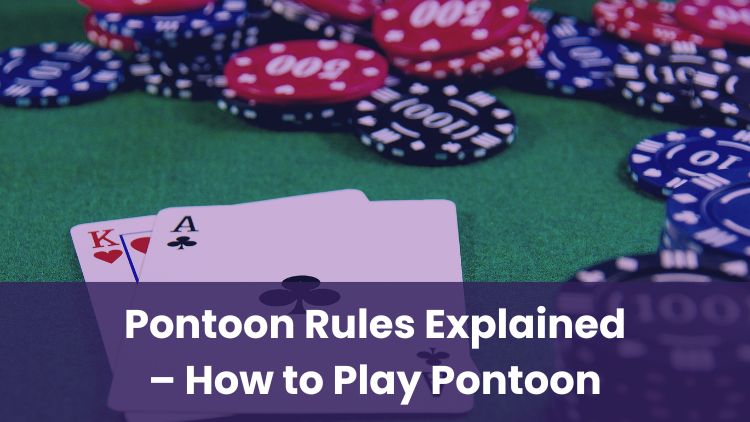
If you have ever sat around a table, card game in hand, and wondered where Pontoon fits in among the likes of Blackjack, you are not alone. Pontoon is a classic British card game with a strong following in homes and casinos across the UK. With its own terms and a few clever twists, it puts a fresh spin on familiar card play.
You might have spotted Pontoon online or heard it mentioned among friends, but not been quite sure how it works. There is no special knowledge needed to learn, just an interest in a quick game where choices and simple maths shape every hand.
This guide breaks down the rules in clear language so you can understand how to play from the first deal. Whether you want to join a friendly game or are simply curious about the way Pontoon is played in the UK, you are in the right place.
How Do You Play Pontoon?
To start a game of Pontoon, you will need a standard 52-card deck and at least two players, although more can join. One player becomes the dealer, and everyone else plays against them. The dealer gives two cards to each player and two to themselves, all face down.
The aim is to reach a total as close as possible to 21 without going over. After receiving your cards, you can choose to twist, which means take another card, or stick, which means keep your current total. If your hand exceeds 21, you are out of that round.
A pontoon is an ace with any ten-value card as your first two cards, and it beats every other hand. A five card trick, which is any five cards totalling 21 or less, is the next best outcome and is only beaten by a pontoon.
Play moves around the table until all players have finished, then the dealer reveals their hand and resolves the round. With the flow in mind, it helps to know exactly how each card counts.
Card Values In Pontoon
As introduced earlier, card values are simple to track and they decide how close you are to 21. Picture cards, meaning kings, queens, and jacks, each count as 10. Number cards use the number shown on the card.
The ace is flexible. It can count as either 1 or 11, whichever gives you the better total without going over 21. For example, an ace with a 7 can be 8 or 18. If 11 would push you over 21, the ace counts as 1.
Suits do not affect value in Pontoon. Only the numbers, picture cards, and aces matter when working out your hand. With values sorted, it is easier to see how the dealer plays their part.
How Does The Dealer Play In Pontoon?
The dealer follows fixed rules. Their two cards are dealt face down and usually stay hidden until all players have taken their turns.
Once players have finished, the dealer reveals their hand and must draw cards until reaching at least 17. If that 17 includes an ace counted as 11, known as a soft 17, many games require the dealer to draw again. They stop only once they have a hard 17 or higher without going over 21.
If the dealer makes a pontoon or a five card trick, those hands are strong, but the dealer still follows the same drawing rules until they reach the stopping point. At the end, every remaining player compares their total to the dealer to settle the round. Knowing how the dealer must act helps with your own decisions on twisting, sticking, and buying.
Hitting, Sticking And Doubling Rules
In Pontoon you will use three main actions: twist, stick, and buy. Each influences how your hand develops.
Twisting means asking for another card. You can keep twisting as long as your total stays at 21 or below. If you exceed 21, the hand ends for you.
Sticking is choosing to receive no more cards, keeping the total you have. Players often stick when their total is already strong and the risk of going over 21 feels too high.
Buying is Pontoon’s term for doubling. You place an extra bet and take one card. You can buy after your first two cards, or after your third or fourth, as long as your total is still 21 or less. After buying, you can twist again if you have fewer than five cards. For example, buying on a total of 9, 10, or 11 is common, as a single added card can move the hand into a competitive range while leaving room to twist if needed.
These options create the rhythm of each round. When pairs appear, there is also the choice to split.
How Do Splits Work In Pontoon?
Splitting applies when your first two cards are a pair, such as two sevens or two picture cards. You can split them into two separate hands by placing an extra bet equal to your original stake. Each hand then receives an additional card, and you play them one after the other.
If you split aces, most games allow only one extra card on each ace. If another pair appears after splitting, some games permit re-splitting, but the exact rule depends on where you play. Once split, each hand stands alone and is settled on its own merits.
Splitting gives you a way to turn one starting hand into two live chances. With that in mind, it is useful to know how wins are paid and how ties are treated.
Payouts And Push Rules
Payouts depend on your result against the dealer. A pontoon, which is an ace with a ten-value card on the first two cards, usually pays 2 to 1. A five card trick also commonly pays 2 to 1. Any other winning hand that beats the dealer typically pays even money, meaning you receive your original stake back plus the same amount in winnings.
Pontoon does not usually feature a push. If your total and the dealer’s are equal, the dealer wins in most games. So if both you and the dealer have 18, your wager is lost.
If you go over 21 or finish with a lower total than the dealer, you lose your stake for that round. If you are ever unsure about a payout, check the table rules before you start, as some venues and online platforms use slightly different pay tables.
If gambling starts to affect your wellbeing or finances, seek support from organisations such as GamCare or GambleAware, and use tools like deposit limits to stay in control.
Common Variations Of Pontoon Rules
Pontoon often features small house rules, so it is worth checking the specifics. One common variation is the number of times you can split pairs. Some places allow re-splitting, while others set a single-split limit.
Dealer behaviour on soft 17 can also differ. In many traditional games, the dealer must draw on soft 17 and stand only on hard 17 or higher. Elsewhere, the dealer may stand on all 17s, which changes how often the dealer improves or busts.
Payouts can vary too. While 2 to 1 for a pontoon or five card trick is typical, some games offer different odds for particular outcomes. Terminology can shift as well, with home rules sometimes renaming actions or adjusting when you can buy. A quick read of the rules before the first hand keeps everyone on the same page.
How Is Pontoon Different From Blackjack?
At first glance, Pontoon and Blackjack look similar, but there are several differences, especially in UK games.
In Pontoon, both of the dealer’s cards are face down, so you have no information about their hand while making choices. In most Blackjack games, one dealer card is visible, which can guide your approach.
The language is different too. Twisting in Pontoon is called hitting in Blackjack. Sticking is standing. Buying in Pontoon mirrors doubling down in Blackjack.
Winning hands also behave differently. In Pontoon, a five card trick, any five cards totalling 21 or under, beats any 21 made with fewer cards. In Blackjack, five card tricks do not have special status. Payouts can differ as well. Pontoon commonly pays 2 to 1 for a pontoon and for a five card trick, while British Blackjack typically pays 3 to 2 only for a natural blackjack.
Once these distinctions are clear, Pontoon stands out as its own game, with simple rules, quick decisions, and a distinct rhythm that many players enjoy.
**The information provided in this blog is intended for educational purposes and should not be construed as betting advice or a guarantee of success. Always gamble responsibly.