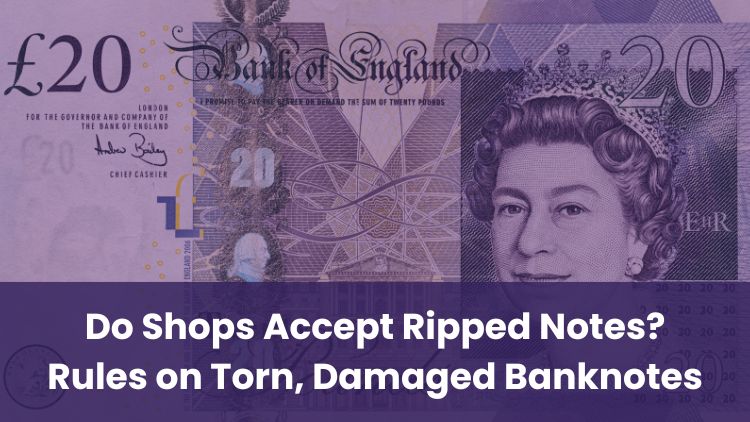
Found a torn note in your wallet and not sure if a shop will take it? You’re not alone. Damaged banknotes turn up all the time, and the rules at the checkout can feel unclear.
This guide explains what counts as damage, how much of a note needs to be there, and what shops look for before deciding. You’ll also find what to do if a note is refused and how to swap severely damaged cash through official channels.
If you want fewer awkward moments at the till, the simple pointers below will help you handle damaged notes with confidence.
Can Shops Refuse Ripped Or Torn Notes?
Yes. Shops in the UK can refuse any banknote that is damaged or looks questionable. Businesses are not obliged to accept cash or a particular note, and staff may turn a note away if they cannot quickly check it is genuine.
Refusals are more likely if a note is badly torn, a chunk is missing, or tape makes it hard to see important features. Some places will accept minor damage if everything still checks out, but it is always a judgement call at the counter.
So what actually qualifies as damage, and where do shops draw the line?
What Counts As A Damaged Banknote?
A banknote is considered damaged if it is not in its original condition. That covers rips, tears, holes, heavy creases, stains or ink marks. Writing on a note can also cause problems, especially if it obscures security features or key details like the Queen’s portrait or denomination.
Polymer notes are tougher than paper ones but can still be cut, melted, shrunk or scuffed. If tape has been used, the concern is whether the repair hides or distorts features such as the see-through window, holographic foil, raised print or serial numbers.
Ultimately, a note is more likely to be accepted if the design is clear and all security features can be checked quickly. If too much is missing or defaced, expect issues at the till.
How Much Of A Banknote Can Be Missing Before It's Unacceptable?
As a rule of thumb, more than half of the note should be intact for it to be considered usable. That aligns with the Bank of England’s approach to exchanges, where a claim is usually assessed only if over 50% of the note is provided.
For day-to-day spending, it still comes down to a shop’s discretion. A missing corner or a small tear might be fine if the important features are there. Heavily cut notes, or those with large sections missing, are far more likely to be refused. Self-checkouts and machines are also less forgiving and tend to reject anything that is torn, folded or taped.
If a note looks patched together, the next question is whether repairs are acceptable.
Do Shops Accept Taped Or Repaired Banknotes?
They might, but it depends on the extent of the repair. A light, single piece of clear tape over a clean tear is often tolerated. Multiple strips, cloudy tape or repairs that cross windows, foil patches or serial numbers are red flags because they make checks harder.
Heavily taped notes also struggle with counting machines and self-checkouts, which can prompt a refusal even if a note is genuine. The cleaner and more readable the note, the easier the decision for staff.
If a repair goes beyond a neat fix, there is a formal route to get your money back.
Bank Of England Rules For Damaged Notes
The Bank of England runs a damaged and contaminated notes service. In most cases, they will assess a claim if more than 50% of the note is present and the security features can be verified. Worn, slightly torn or creased notes are often still fine to spend, but badly damaged ones can be sent in for review.
The process is straightforward: complete the form on the Bank of England’s website, post the note as instructed, and wait for assessment. Where a claim is approved, payment is usually made by bank transfer. Depending on the case and volume of claims, it can take a little time.
Knowing this option exists is helpful when a note is too far gone for the till.
Where Can I Exchange Severely Damaged Or Cut Notes?
Severely damaged or cut notes are rarely accepted by shops. The most reliable option is the Bank of England’s service described above. Their website explains what to include with your claim and how to post notes securely so they can be checked and, if eligible, replaced.
Some high street banks will assist their own customers, either by examining the note in branch or by forwarding it to the Bank of England on your behalf. Not every branch offers this, so calling ahead can save a wasted trip.
If you need to use the money sooner, consider depositing the remaining balance into your account through your bank and letting them advise on the best next step.
How To Prove A Damaged Note Is Genuine At The Till?
When a damaged note is presented, staff will usually check familiar security features. On polymer notes, that includes the see-through window, holographic foil patches that change under light, raised print you can feel, microlettering, and details that respond under UV lamps. If those features are still clear and consistent with other notes of the same type, the note is more likely to be accepted.
If there is any doubt, staff may compare it to another note, run it through a verifier or decide not to take it. A refusal is not a statement that a note is fake; it can simply mean there wasn’t enough to check with confidence at the time.
What To Do If A Shop Refuses Your Damaged Note?
If a note is declined, the quickest fix is to pay another way and keep the note for later. Trying another shop might work, but repeated refusals are a sign that the damage goes beyond what a cashier can reasonably accept.
In that situation, take the note to your bank. Staff can look at the condition, advise whether it is worth attempting to exchange, and, if appropriate, help you submit it to the Bank of England. If more than half remains and security features are readable, there is a fair chance of recovery through the official process.
Practical Tips To Avoid Problems With Damaged Cash
A few simple habits reduce the hassle. Keep notes flat in a wallet or purse, not loose in pockets or at the bottom of a bag. Avoid stapling, pinning or writing on them. Keep polymer notes away from high heat and strong solvents, and resist the urge to overdo repairs with tape. If a note looks tired, swap it at your bank before it becomes unusable.
If you plan to pay cash at a counter where checks are strict, carry notes that are clean and easy to verify.
**The information provided in this blog is intended for educational purposes and should not be construed as betting advice or a guarantee of success. Always gamble responsibly.