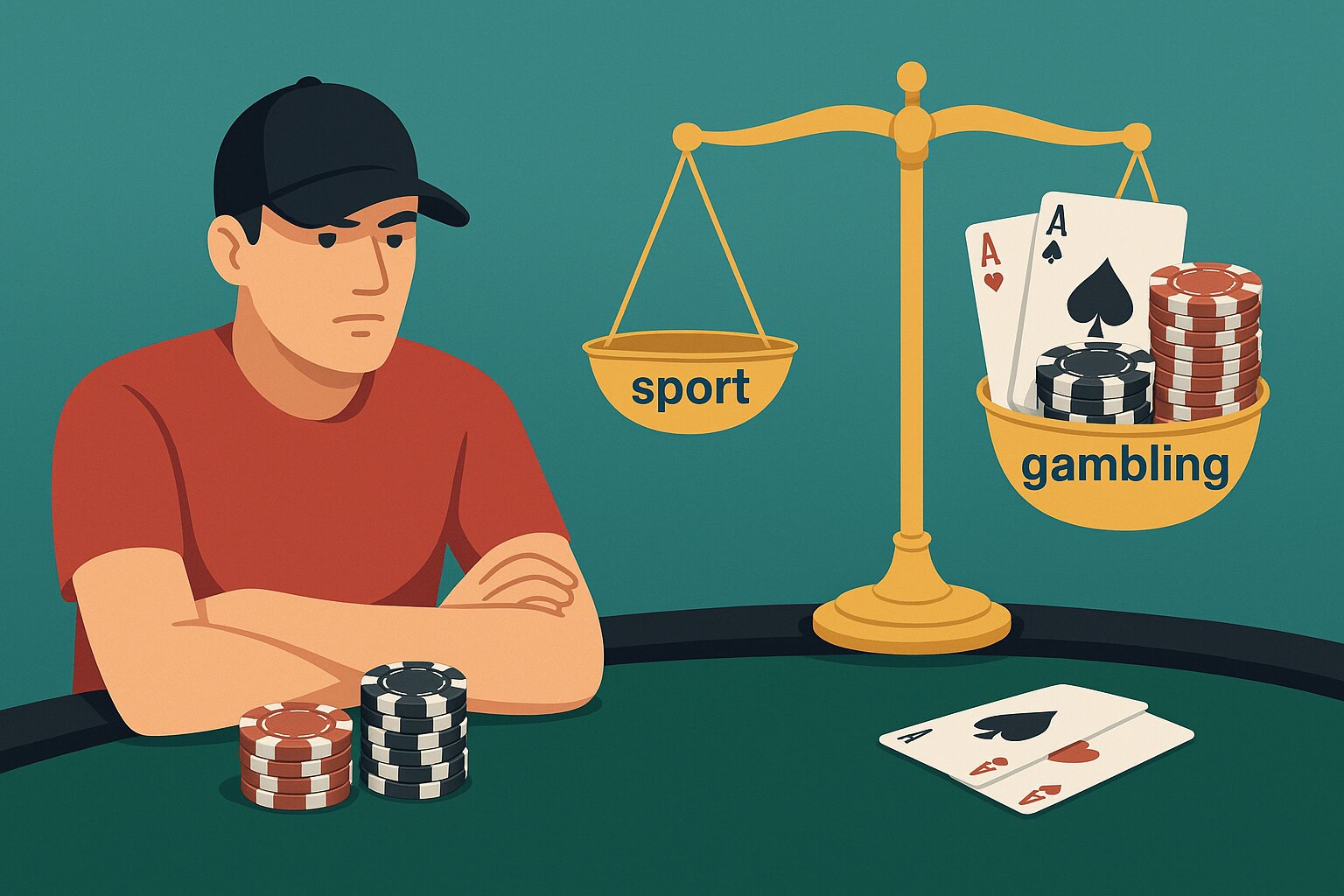
Ever found yourself caught in a heated debate about whether poker should be seen as a sport or simply a form of gambling? You’re not alone — the boundary between skill, chance, and competition blurs whenever someone deals the cards.
In pubs, at home, or online, poker attracts millions who believe there’s more to it than mere randomness. Some compare it to chess, pointing to strategy and psychology; others note that the cards can still change the course of a game.
But what does the law say about poker in the UK? Does the competitive nature of tournaments make it a sport, or does the element of chance place it firmly within gambling? Let’s take a clear look at both sides, weigh the facts, and see where poker stands today.
The Origins and Evolution of Poker
Poker’s story stretches back centuries, with early versions appearing in different cultures. Most historians trace its modern form to the United States in the early 19th century, where it developed into a recognisable game with betting and bluffing as core features.
Initially played on riverboats along the Mississippi, poker spread across the US as rules evolved and new variants emerged. The addition of wagering and psychological play gave it a distinct character compared with other card games.
As organised casinos grew in the 20th century, poker became a fixture on their floors and later moved into homes and onto digital platforms. The arrival of online poker in the late 1990s and early 2000s made the game accessible to a far wider audience, and by the 2000s it had established both casual play and professional circuits.
Today, poker is played socially, competitively, and professionally under formal rules and in international tournaments. Its long evolution left the game balancing skill, chance, and competition — the same ingredients that sustain the debate over its nature.
Comparing Poker with Traditional Sports
At first glance, poker and sports such as football or tennis may seem very different. Physical exertion is central to many sports, whereas poker relies on mental agility and decision-making. Yet both arenas reward preparation, practice, and tactical thinking.
A clear similarity is the competitive element. Players study opponents, plan strategies, and adapt as a match progresses. Tournaments create structured competition with rankings and prize money, much like sporting events.
A key difference is the continued presence of chance in poker. Even the most skilled player can face an unfavourable sequence of cards, and short-term outcomes may not reflect long-term ability. That interplay between skill and chance is why poker is treated differently under UK law: the element of chance is sufficient for it to be classified as gambling.
Understanding how skill and chance interact helps explain why poker attracts such varied opinions and why its legal status remains significant.
How Do Skills and Competition Feature in Poker?
Poker rewards players who can estimate probabilities quickly, control emotions under pressure, and interpret behaviour at the table. Over time, study and experience tend to improve decision-making, tournament play and bankroll management.
Competition is central: players measure themselves in heads-up matches, ring games and multi-table tournaments. Success in the long run tends to favour those who combine strategic thinking with disciplined financial control.
That said, outcomes in any single session can swing away from expectations, so players who approach poker as entertainment and who manage their spending and time tend to have the healthiest experience.
Legal Definitions: Is Poker Classified as Gambling?
In the UK, poker is legally classified as a form of gambling under the Gambling Act 2005. The law focuses on the staking of money on an event that involves an element of chance, and poker meets that definition whether played in a casino, club or online.
Regulation falls to the relevant authority that oversees gambling activities, which requires operators to be licensed, run fair games and meet standards for consumer protection. These rules apply across premises and online sites offering poker for money.
The legal classification also determines age limits: participants must be at least 18 years old to play for stakes. Operators are required to verify age and identity, and to follow standards designed to reduce harm.
This regulatory framework shapes how poker is organised and presented in the UK, influencing everything from tournament structures to advertising and customer checks.
Debunking Common Myths About Poker
There are several persistent misconceptions about poker. One is that a small set of strategies guarantees regular wins. In reality, strategy and experience improve long-term prospects but do not eliminate the influence of chance on short-term results.
Some people assume poker is less risky than other forms of betting. The truth is that financial swings can be comparable to other gambling activities; the potential for loss is real whether a player is experienced or a newcomer.
Another myth is that poker is a reliable way to earn steady income. While a minority do make a living from the game, most players do not turn a consistent profit. For many, poker remains a competitive pastime rather than a primary source of income.
If concerns about play arise, support services exist to help those who need them, and players should be mindful of their own limits.
Public Perceptions: What Do People Think About Poker?
Public attitudes are varied. Some people see poker as a contest of skill and strategy, while others view it primarily as gambling. Surveys suggest generational and cultural differences in perception, with visibility from televised events and online play shifting opinion for some groups.
The growth of online poker and televised tournaments has brought the game into mainstream awareness and drawn new audiences. That exposure has normalised competitive play for many, while others remain cautious because of the financial risks involved.
Campaigns and research into gambling behaviours highlight where misunderstanding can lead to harm, encouraging clearer information for those who choose to play. Overall, poker occupies a complex place in public life: respected by some, treated warily by others.
The Role of Poker in Modern Culture
Poker appears frequently in films, books and television, often used to convey tension, risk and psychological play. Televised tournaments and streaming have also popularised certain formats and players, bringing the mechanics of high-level play to a wider audience.
While a handful of players pursue poker professionally, most participants play at low stakes among friends or online, using it as a form of social and competitive entertainment. The way it features in culture tends to highlight skill, strategy and the drama of tournaments without presenting it as a guaranteed way to earn.
Media exposure has changed how people learn about the game, with tutorials, analysis and livestreams making advanced concepts more accessible. That visibility can inspire interest, but it also raises the need for clear information about the financial risks involved in real-money play.
Conclusion: The True Nature of Poker
Poker sits squarely between skill and chance, and that dual nature is what makes the game intriguing and controversial. Strategy, psychology and competition all matter, yet the presence of chance means outcomes cannot be fully predicted.
Under UK law, poker is treated as gambling, which brings specific regulatory requirements including age checks and fairness standards. Players should understand those rules and the financial realities of the game.
Approached sensibly, poker can be an engaging pastime that rewards study and discipline. Keep an eye on your spending and time, and seek help if play becomes a problem. If you want to explore more about poker formats, tournament structures or managing play, we cover those topics elsewhere on the site.
**The information provided in this blog is intended for educational purposes and should not be construed as betting advice or a guarantee of success. Always gamble responsibly.