
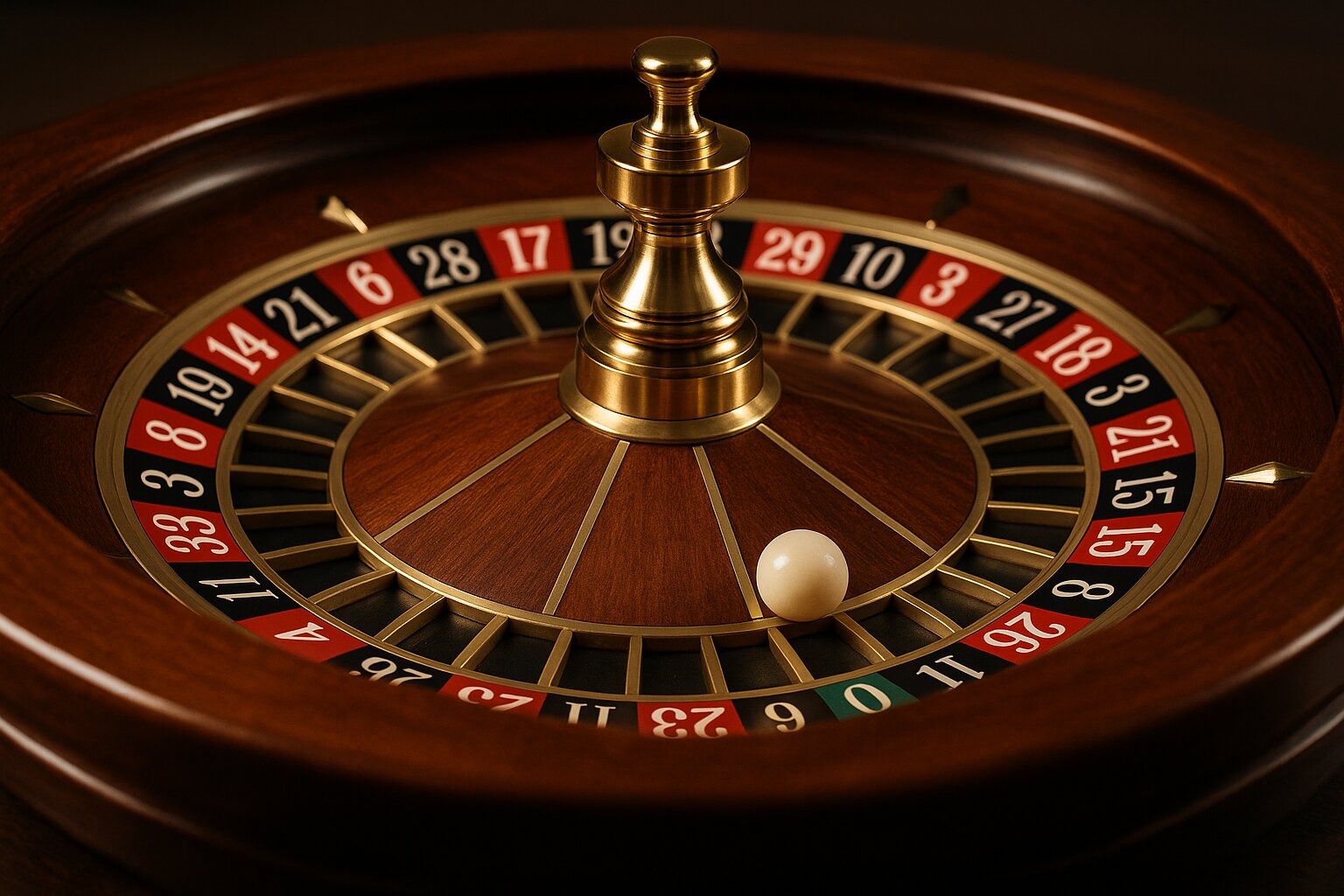
If you've ever watched a roulette wheel, you might notice numbers turning up more than once and wonder how often that happens. The answer lies in probability and how each spin is produced, not in any pattern the wheel keeps.
This article explains what repeating numbers are, how their chances are calculated, and what repeated results can— and cannot—tell you about the game. Read on to get a clearer, practical view of how repetition fits into the wider picture of roulette.
What Are Repeating Numbers In Roulette?
Repeating numbers are simply instances where the same pocket appears more than once across several spins. For example, if 17 lands and later 17 shows up again, that is a repeat. The interval between repeats can be one spin, ten spins or far longer; only the raw outcome matters.
Because each spin is produced independently, repetition is a normal part of play rather than evidence of a pattern. Players sometimes interpret repeats as signs that a number is “hot” or “cold,” but those impressions are based on how humans look for patterns, not on how probabilities behave.
Understanding repetition starts with accepting that chance governs each spin. With that in mind, the next section looks at the concrete maths that explains how repeats occur.
How Is The Repetition Of Roulette Numbers Calculated?
Repetition is analysed using basic probability. A European roulette wheel contains 37 pockets, labelled 0 to 36, so any specific number has a 1 in 37 chance of appearing on a given spin. An American wheel adds a double zero and has 38 pockets, making the single-number chance 1 in 38.
To estimate the chance of a number repeating, probabilities for the required outcomes are combined. For instance, the chance of a particular number landing twice in immediate succession on a European wheel comes from multiplying 1/37 by 1/37. When you stretch that idea to longer sequences or different intervals, similar multiplication and combinatorial reasoning apply.
These calculations are descriptive rather than predictive. They tell you how likely particular sequences are, not that any specific future spin will follow them. With that understanding in place, we can look at a common question about immediate repeats.
What Are The Chances Of The Same Number Appearing Twice In A Row?
On a European wheel (37 pockets) the probability of the same number appearing on two consecutive spins is 1/37 times 1/37, which equals 1 in 1,369. On an American wheel (38 pockets) the equivalent figure is 1 in 1,444.
Those figures do not change from spin to spin. The independence of each spin means that even after a repeat has occurred, the mathematical chance of another immediate repeat remains the same as before. This is why treating each spin as a separate event is essential when interpreting results.
If you are curious how repeats behave over larger numbers of spins, the same principles of multiplication and probability apply, and they quickly show why certain short streaks, though memorable, remain uncommon.
Do Different Roulette Wheels Affect Repeating Numbers?
The main practical difference between wheel types is simply the number of pockets. More pockets reduce the probability that any single number will appear, which in turn makes exact repeats slightly less likely on wheels with more pockets.
Wheels also vary in design and maintenance. A well-built and properly maintained mechanical wheel should produce outcomes consistent with random distributions for its configuration. Online versions rely on certified random number systems to achieve the same effect.
If you play in regulated venues or on tested online platforms, you can expect the mechanisms producing spins to meet established fairness standards. That helps ensure repeating patterns reflect chance and not mechanical faults.
Common Myths About Roulette Number Repeats
Several myths surround repetition. One is that a number that has appeared recently is “hot” and therefore more likely to reappear. Another is the converse idea that a number that has not appeared for a long time is “due.” Both ideas misunderstand independence: past results do not change the mathematical probabilities for future spins.
Some players try to base strategies on runs of repeated numbers, but statistical studies and simple probability show these approaches do not alter expected outcomes. Treating these myths as facts can lead to poor decisions about stake sizes and game choices.
Keeping a clear view of the underlying mathematics is the best way to avoid being misled by apparent streaks or dry spells.
Can Repetitions In Roulette Indicate Faulty Wheels?
Repeated occurrences concentrated in one area of a mechanical wheel can sometimes point to a problem. Wear, damage, or an uneven frame can bias where the ball tends to settle. Observers in a casino setting have historically called staff attention to such patterns, and venues are obliged to investigate.
In regulated environments, routine checks, maintenance and calibration are part of normal operations. Online providers use certified testing to confirm their random number systems operate within expected statistical limits.
So while repetition can occasionally flag a physical issue, in most well-regulated contexts it is just part of ordinary probability rather than evidence of a faulty wheel.
Are Repeating Numbers Purely Random In Roulette?
Repetition stems from the same source as any other roulette outcome: the random process that generates each spin. For mechanical wheels that process is the physical interaction of ball and rotor; for digital games it is a certified random number generator. Both are designed so past results do not influence future ones.
Physical wheels are engineered with precision to avoid predictable bias, and casino operators monitor them to maintain that standard. Online systems undergo independent testing to confirm the distribution of outcomes matches theoretical expectations.
While repeated numbers attract attention because they stand out, they do not imply influence from earlier spins. Rather, they are an expected feature of repeated random trials. With that, you should have a clear, complete picture of how repetition fits into roulette and what it does — and does not — signify.
Your next spin will follow the same rules described here, and the best approach is to treat the game as a form of entertainment where outcomes follow straightforward probability.
**The information provided in this blog is intended for educational purposes and should not be construed as betting advice or a guarantee of success. Always gamble responsibly.