
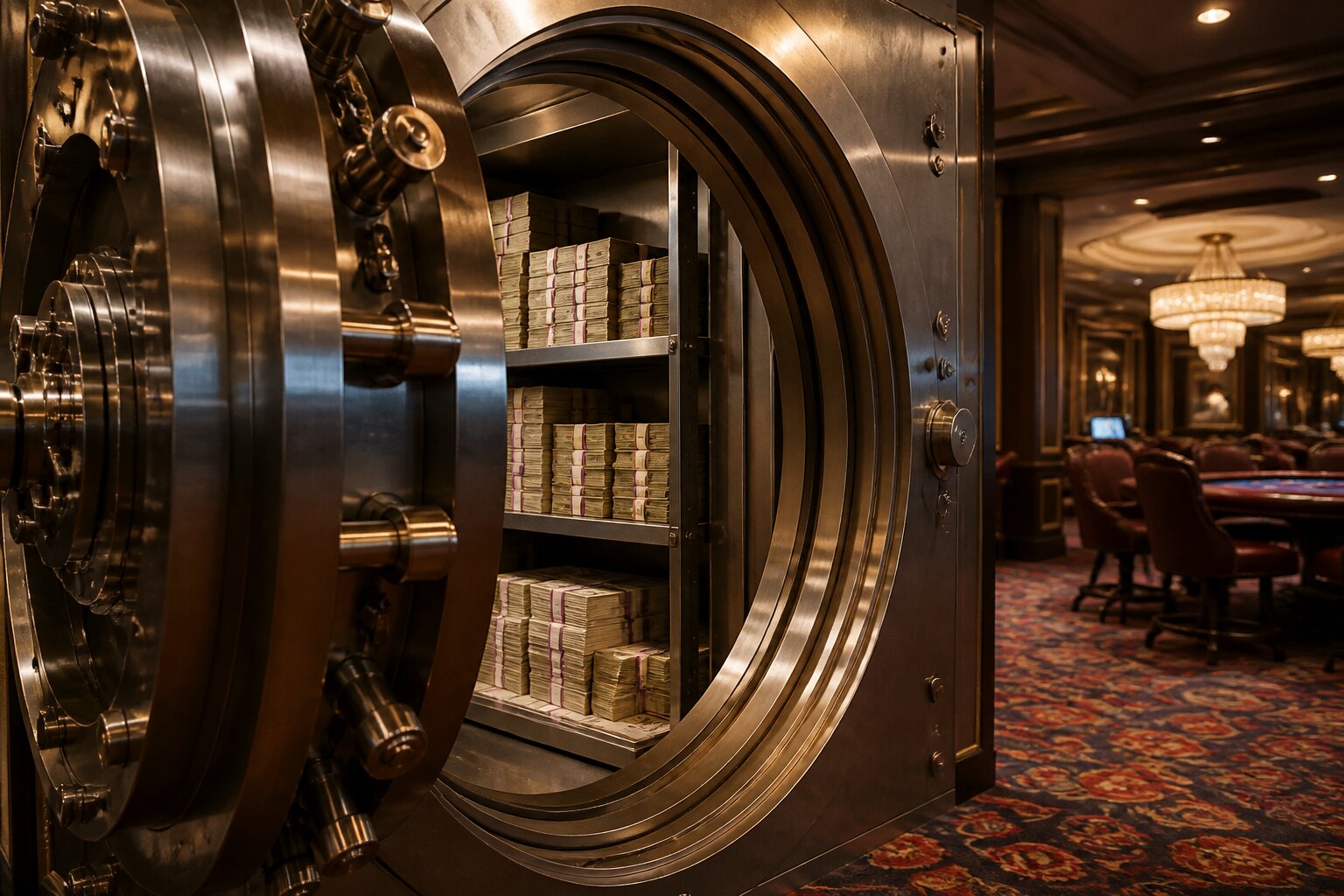
Ever wondered how much money sits behind the scenes at your local UK casino? It is a question many visitors ask, whether they are watching a game or thinking about possible payouts. The real picture is more practical than dramatic.
Beneath the gaming floor there are systems, processes and strict controls designed to keep the business running and to protect customers and staff. With regulation and modern security technology, cash handling is a tightly managed operation rather than a spectacle.
If you want to know what is kept in vaults, why certain amounts are held, and how cash is protected, this guide walks through the main facts in clear, practical terms.
Why Do Casinos Keep Cash On Site?
Casinos hold cash on site so daily operations run without interruption. A float is set aside for each gaming table and till to ensure payouts, chip exchanges and immediate customer needs are met. This prevents delays and keeps transactions straightforward for guests who prefer to use cash.
Cash on hand also makes it easier to deal with a range of payout sizes, from small wins to larger prizes. But the amount kept is calculated carefully and adjusted according to likely demand, with an emphasis on safe handling and compliance with financial rules.
Behind the scenes there are anti-money-laundering checks and record-keeping requirements that determine how cash is accepted, stored and reported. These controls make sure that keeping cash on site supports the customer experience without creating undue risk.
How Do Casinos Store and Secure Their Cash?
Cash is stored in secure areas such as reinforced vaults and locked safes, with physical protection designed to industry standards. These areas are constructed and maintained to prevent unauthorised entry and to protect the funds from theft or damage.
Access is strictly limited to trained, authorised staff and every movement is recorded. Security teams provide continuous monitoring, and sophisticated alarms and surveillance systems add further layers of protection. Regular audits and strict inventory checks ensure discrepancies are spotted and investigated quickly.
Together, these measures create a secure environment where cash can be handled reliably while meeting regulatory and operational needs.
What Factors Influence the Amount of Cash in a UK Casino?
Several practical factors determine how much cash a casino holds at any given time. Larger venues with more tables and machines require a bigger float to match customer activity. Certain games, which may involve higher typical payouts or chip exchanges, influence the level of reserves needed at those tables.
Visitor numbers and the time of day or week also change requirements. Busy evenings and weekends lead to higher cash needs than quiet weekday afternoons. Seasonal events or big tournaments can temporarily increase the amount of cash a venue keeps on site.
All of these considerations are balanced against regulatory and financial controls so that the amount on hand fits operational demand without creating unnecessary exposure.
We will now look at how those funds move in and out of the casino to keep levels appropriate.
How Often Do Casinos Replenish or Remove Cash?
Cash levels are managed continuously. Front-of-house staff perform daily counts and routine audits to confirm what is on site. Tills or gaming tables that fall below set thresholds are topped up swiftly but securely to keep play uninterrupted and tills accurate.
At the same time, scheduled collections move excess cash out to banking partners so large sums do not accumulate on the premises. These collections are planned to balance operational need with the security imperative of minimising on-site holdings.
These movements follow clear procedures, with checks and records maintained at every stage. Staff complete logs and reconciliation forms, and electronic systems often track cash movements in real time. Supervisors routinely review these records to spot discrepancies and ensure accountability.
When cash is transported, it is done under secure conditions and often with professional carriers. Typical safeguards include:
- sealed cash bags or locked cash boxes with tamper-evident seals
- dual control where two authorised staff members are present for handovers
- use of armoured vehicles or licensed security firms for off-site transfers
- CCTV coverage and secure routes within the building for internal movement
This combination of replenishment and removal keeps operational needs met without leaving unnecessary amounts exposed. Regular audits, staff training and adherence to written procedures help maintain a strong control environment and reduce the risk of loss or misuse.
Are UK Casinos Required to Disclose Their Cash Holdings?
Casinos are not required to disclose exact figures about how much cash they hold to the public. That information is treated as sensitive for security reasons, and making precise totals public could create safety and criminality risks. Operators therefore keep those figures confidential from customers and the general public.
However, casinos must maintain records and provide certain details to regulators and financial authorities as part of licensing and anti-money-laundering obligations. These requirements support supervision and help prevent financial crime while allowing operators to protect operational security.
Typical information that operators are expected to record and make available to authorised bodies includes:
- cash transaction logs and reconciliation records
- deposit and withdrawal summaries that link to banking records
- registers of large or unusual transactions and customer due diligence checks
- reports of suspicious activity submitted to the appropriate financial intelligence unit
- any audit and compliance documentation required by the licence conditions
Regulators and authorised agencies can request and review these records as part of their supervisory role. Inspections, audits and requests for information allow oversight and accountability without forcing casinos to publish precise cash totals to the public.
Is Casino Cash Accessible to Staff and the Public?
Access to cash is tightly controlled. Members of the public do not have access to vaults or secure cash storage, and only specific, authorised employees handle funds. Roles and responsibilities are clearly defined so that no single person controls all aspects of cash movements.
Every handling event is logged, and segregation of duties is used so that checks are built into the process. This reduces the risk of error or misuse and supports reliable record keeping. The result is a framework where cash is available for customer needs but protected by rules and oversight.
Security procedures in one area influence practices across the whole venue; next we look at the specific protections used for vaults.
What Security Measures Protect the Casino Vault?
Vaults are protected by a mix of physical and electronic controls. Reinforced doors, safes with secure locking mechanisms, and restricted-key systems form the physical barrier. Electronic access control, CCTV and motion sensors add layers of monitoring.
Operational safeguards include defined access lists, scheduled audits and tamper-evident seals on transfers. Personnel controls such as background checks and training help ensure only trustworthy staff are involved in cash handling. Together these systems create multiple lines of defence that work in concert.
What Happens if a Casino Runs Out of Cash?
Running out of cash is very unlikely because venues plan for typical and peak demand. Cash levels are monitored continuously and staff are trained to spot when reserves are running low so action can be taken before customers are affected.
If levels fall unexpectedly, contingency arrangements are available. These may include:
- secure cash deliveries from off-site reserves arranged through vetted suppliers,
- transfers handled with banking partners to replenish tills and cashier stations,
- temporary use of vouchers, electronic payments or delayed electronic payouts while cash is restored.
Any such action is carried out discreetly and with the same security standards applied to routine cash movements. Staff follow strict procedures for handling, counting and transporting funds, and movements are logged to maintain accountability and reduce risk.
The aim is to ensure customers receive payouts and services without disruption. Where a short delay is unavoidable, customers are informed promptly and offered clear options for receiving their money once normal service is restored.
Common Myths About Casino Vaults and Cash
There are several common misunderstandings about casino cash holdings. One is that vaults are full of visible stacks of money. In truth, amounts are kept at operationally necessary levels, tightly controlled and rarely stored in bulk on site.
Another misconception is that many staff have easy access. In reality, access is limited and monitored, and duties are separated to prevent any single point of failure. People also sometimes believe visible cash levels reflect how successful a venue is, but cash holdings are functional rather than promotional.
These facts underline that cash management is focused on safety, compliance and efficient operations rather than spectacle.
Can You Ask How Much Cash Is in a Casino?
Guests do sometimes ask about cash levels out of curiosity. For security and regulatory reasons, venues do not disclose those details.
Staff can explain general practices, such as:
- how cash is secured on the premises
- the procedures for counting and reconciling money
- how registers and cashiers are managed to meet customer needs
- the use of surveillance and other controls to protect funds
Those explanations aim to reassure customers about safety and customer service, but specific totals are not shared because doing so could pose security risks and may conflict with regulatory requirements.
If you have other questions about how the casino operates or about services available during your visit, staff are usually happy to help within the limits set by security and regulation.
Summary of Key Facts About Casino Cash Holdings
Below is a concise round-up of the main points to take away about how casinos handle cash.
Casinos manage cash to meet daily operations while maintaining strict security and regulatory compliance. Records are kept and reported to authorities as required, and access to stored cash is tightly limited and monitored. Cash levels are determined by venue size, game types, visitor numbers and operational needs, and movements of funds are scheduled and secured to prevent accumulation. Overall, the priority is safe, compliant management rather than displaying or holding unnecessary sums.
**The information provided in this blog is intended for educational purposes and should not be construed as betting advice or a guarantee of success. Always gamble responsibly.