
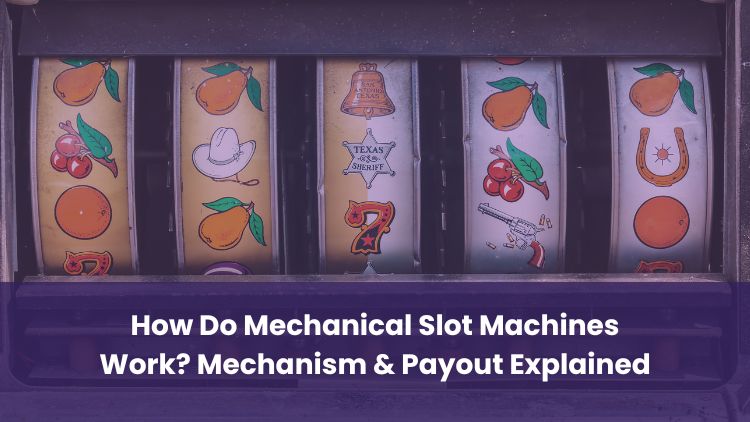
Mechanical slot machines have long been a favourite on the casino floor, with their spinning reels, metal housings and coin payouts drawing people in. But what actually happens inside the cabinet when the handle is pulled?
This blog post breaks down the key parts, shows how wins are detected and paid, explains how the house edge is set, and highlights the differences between classic mechanical models and today’s electronic slots. We also clear up a few myths so the picture is accurate rather than hearsay.
Outcomes on slot machines are random and each spin is independent. If you choose to play, set personal limits that suit your circumstances and stick to them.
What Were The Main Mechanical Parts Of A Slot Machine?
Classic mechanical slot machines were built from sturdy components that worked together to produce each spin and, when appropriate, pay out coins:
- Reels: Inside the machine, three or more metal reels held printed symbols such as fruits, bars and sevens. The reels rotated independently on a central shaft and were visible through a front window.
- Lever or Handle: Pulling the side lever engaged the internal mechanism that set the reels in motion. The action also primed the braking parts that would later stop each reel.
- Gears and Springs: A network of gears, cams and springs transferred the force from the lever to the reels, controlled their speed and brought them to a halt at defined positions.
- Payout Mechanism: A coin hopper stored coins and, when triggered, counted and released the correct number into the payout tray. A simple counting device ensured the right total was dispensed.
- Coin Slot and Coin Path: Coins entered through a front slot, moved along a set path and were checked for size and type before activating the play mechanism.
Together, these parts produced a repeatable process with outcomes selected by the way the reels stopped. With the components in mind, it helps to look more closely at how the reels spin, slow and settle.
Reel Assembly And Stop Mechanism
Mechanical reels were mounted on a central shaft and rotated freely once the lever was pulled. Around each reel’s edge, symbols were printed at fixed positions that could line up along the viewing window.
Stopping relied on a system of notches on each reel and a matching catch inside the machine. As the internal springs lost energy and the gears slowed the reels, the catches engaged with the notches. Each catch dropped into place at a particular point, holding the reel on a precise symbol.
Crucially, the reels did not all stop together. The mechanism was built so that each reel slowed and locked independently, which prevented patterns and kept the results unpredictable from one spin to the next.
Once the reels were stopped, the next job was to decide whether the symbols that landed across the payline formed a recognised win.
Payline, Symbols And Winning Combinations
A payline is the path across the reels that the machine checks for wins. On many early models there was a single horizontal line across the centre. Some later machines added extra lines, including diagonals.
Each reel carried a pre-set sequence of symbols arranged by the manufacturer. When the reels stopped, the machine compared the symbols on the active payline to the paytable. If they matched a listed combination, the machine recorded a win and prepared a payout.
This simple idea underpins all slot games: a defined line, a fixed arrangement of symbols on each reel and a paytable that states what each combination returns. To see how often those combinations can appear, it helps to look at reel stops and strip layouts.
How Do Reel Stops And Strip Layout Affect Payouts?
The strip layout is the exact order of symbols around each reel. Every physical position a reel can land on is a stop. By choosing how many stops a reel has and which symbols occupy them, manufacturers decide how likely each outcome is.
Symbols tied to higher returns are placed less often, which makes their appearance rarer. More common symbols appear in multiple positions, so they turn up more frequently. For instance, if a top symbol appears once on each of three reels with 20 stops each, the chance of all three lining up on the single payline would be 1 in 8,000.
Because the strip layout shapes the probability of every result, it also shapes how often different payouts occur. That balance is what gives the machine its overall return profile. With the maths set on the reels, the physical coin and payout hardware takes over when a win is detected.
Coin Mechanism, Coin Path And Hopper Payouts
Mechanical machines were built for coins. After insertion, each coin followed a guided path where its diameter and thickness were checked by simple gauges. Acceptable coins dropped into the mechanism that enabled the spin, while others were rejected back to the tray.
When a winning combination was confirmed, the coin hopper was activated. The hopper stored a float of coins and used a rotating disk or wheel to count out the exact number required. Coins then rolled through to the payout tray for collection. If the hopper ran low, staff refilled it before the machine returned to service.
All of this worked with physical parts and straightforward electrics, which leads naturally to how the machine knew a win had occurred in the first place.
How Were Wins Detected And Payouts Triggered?
Win detection relied on the stopped position of the reels. Certain symbol locations were linked to small pins or contact points. As the reels came to rest, a set of arms or feelers checked those points. If the right combination lined up across the payline, the contacts closed a simple circuit.
Closing the circuit told the machine to award the listed prize. The same signal triggered the hopper to start counting out coins until the required amount had been dispensed, after which the circuit opened and the payout stopped.
This process was automatic and repeatable, driven by the hardware rather than by any player action once the lever had been pulled.
How Did Manufacturers Set The House Edge On Mechanical Machines?
The house edge was baked into the reel design. As described earlier, manufacturers chose how many stops each reel had and how often each symbol appeared. By adjusting those proportions, they controlled the frequency of every winning combination.
From there, they built a paytable that matched those frequencies. Rare results were given higher returns, while common results paid smaller amounts. The combined effect determined the machine’s long-term payout percentage, and the difference between that percentage and 100% is the house edge.
Each spin remained an independent event, but over many plays the designed probabilities guided the overall results.
How Do Mechanical Slot Machines Differ From Modern Electronic Slots?
Mechanical slot machines rely on moving parts: levers, springs, gears and metal reels. Wins are detected by physical contacts, and payouts are in coins from a hopper. Play typically involves inserting coins and pulling a lever.
Modern electronic slots use software and random number generators to select outcomes. The reels and symbols are digital images controlled by a programme, while credits and payouts are managed electronically rather than with coins. These machines can also offer multiple paylines, on-screen bonus features and game modes that are not possible with purely mechanical hardware.
Despite the different technology, the principle is the same: outcomes are generated at random within the design of the game, and previous results do not affect the next spin.
Common Myths About Mechanical Slot Machines Debunked
A frequent myth is that pulling the lever at a particular moment changes the result. It does not. Once the lever is pulled, the mechanism runs its course and the reels stop as the internal parts dictate.
Another belief is that a machine is “due” after a series of losses. Mechanical slots do not track past results. Each spin is separate, and the previous outcome does not make a future win more or less likely.
Some players think attendants can change settings during play. On mechanical models, changing the payout behaviour involves opening the machine and physically altering components, which is done only when the machine is out of service.
There is also the idea that machines pay on a schedule or more often at busy times. Payouts happen when the required symbols line up, not at set intervals.
If you choose to play, keep it within limits you can afford, take breaks and treat it as occasional entertainment. If gambling starts to affect your well-being or finances, seek support early. Independent organisations such as GamCare and GambleAware offer free, confidential help.
Play Slots Online at Thor Slots
Thor Slots is licensed and regulated by the UK Gambling Commission, with tools that help you manage your play in a way that suits you, including deposit limits, time reminders and self-exclusion.
You’ll find a range of slot games, from classic-style titles to jackpot and Megaways games, so it’s easy to pick something that matches your preferences.
If you’d like to join us, feel free to create an account at Thor Slots, add funds in an amount you’re comfortable with and explore the games at your own pace. Keep your limits in place and enjoy responsibly.
**The information provided in this blog is intended for educational purposes and should not be construed as betting advice or a guarantee of success. Always gamble responsibly.