
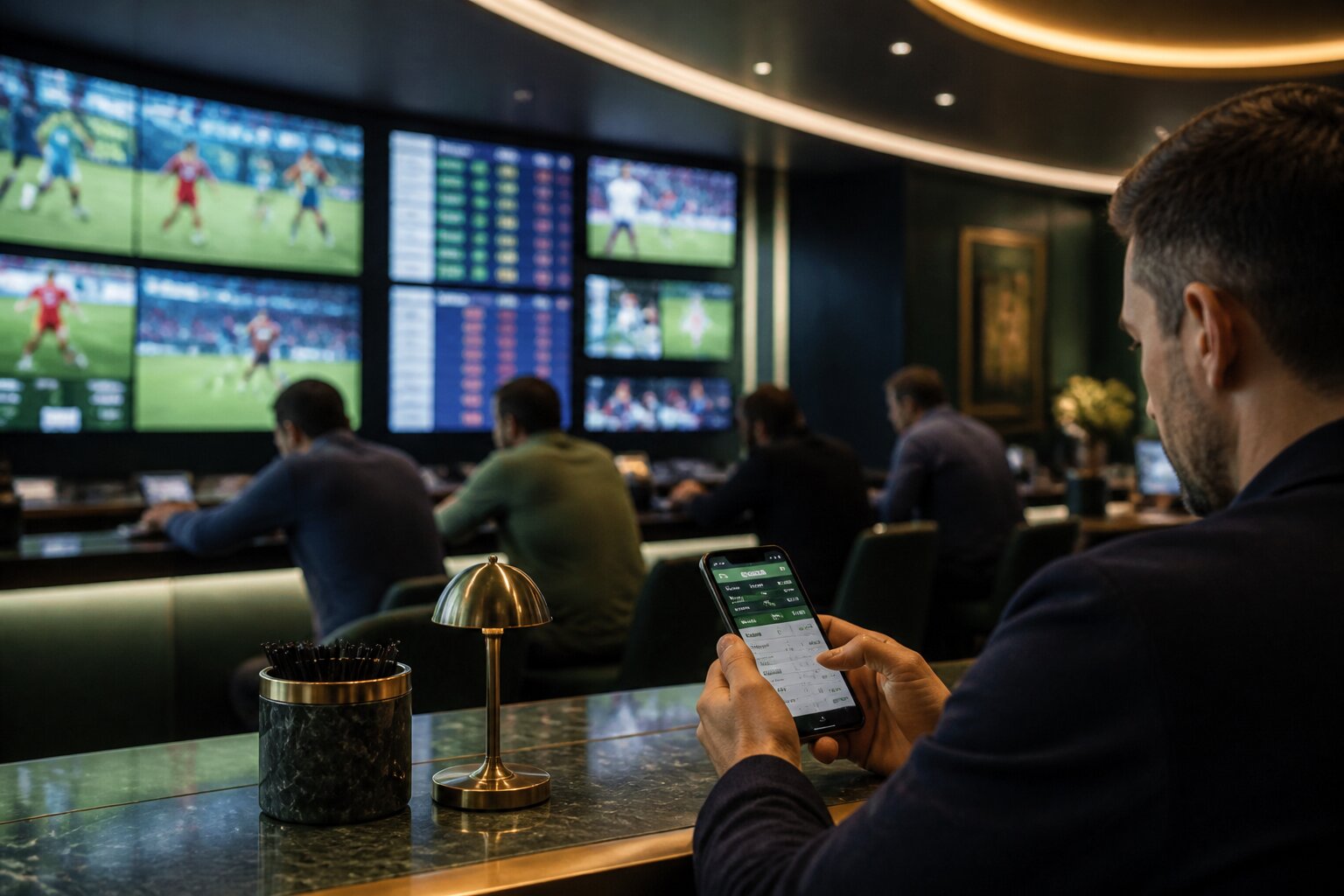
Have you ever wondered why casinos offer so many sports betting options and how they make a steady return from them? Sportsbooks present a wide range of markets and odds, but the headline mechanics are straightforward once you know what to look for.
This article breaks down the core elements behind sportsbook profitability: how odds are set, why they move, the role of margins, and how different bet types affect the house edge. Read on to follow the thread through each part of the operation and pick up practical context along the way.
How Do Sportsbooks Operate?
Sportsbooks begin by creating the markets and setting the initial odds. Oddsmakers use data, statistics and expertise to estimate the probabilities of possible outcomes, then adjust those figures so the book generates a margin. That margin, applied across many markets, is what makes the operation sustainable.
Once the markets are live, bets are taken and the book manager watches how money flows across selections. If too much is placed on one outcome, odds are shifted to encourage betting on other outcomes and reduce exposure. After an event, the sportsbook settles winning bets and retains losing stakes, with modern systems automating much of this in real time.
The next section explains the single most important concept that underpins these adjustments: the overround, sometimes called the bookmaker’s margin.
What Is the Overround and How Does It Work?
The overround is the built-in margin that lets a sportsbook remain profitable over the long term. By setting odds so the total implied probability of all outcomes exceeds 100%, the bookmaker ensures that payouts are slightly lower than the true statistical expectation. That excess percentage is the margin.
The Concept of Bookmaker Margin
Every set of odds includes a margin. In a perfectly fair market, the implied probabilities would sum to 100%. By offering slightly lower odds, the sportsbook raises that total above 100% and secures a mathematical edge.
This margin helps the operator manage risk and cover running costs such as staff, technology and regulatory fees, while still offering competitive markets. The margin is not intended to make markets unfair to customers, but to ensure the business can operate sustainably over time.
Bookmakers also use the margin as a tool to balance their books. By adjusting odds, they can encourage bets on particular outcomes and reduce their exposure. Over time and across many events, this approach helps them smooth out liability and maintain consistent returns.
Calculating the Overround in Practice
You can convert decimal odds into implied probabilities by dividing 1 by the decimal figure, then adding the probabilities for all outcomes. For example, if each side of a two-way event is priced at 1.91, their implied probabilities are each about 52.4%. Together they total roughly 104.8%, so the extra 4.8% is the bookmaker’s margin.
This same method applies to events with three or more possible outcomes. For instance, in a three-way football market the implied probabilities of home, draw and away would each be calculated and then summed. Any amount above 100% represents the overround.
Understanding the overround helps explain why odds move. Changes in market information, liability concerns or shifts in betting patterns can all cause bookmakers to alter prices to manage their margin and exposure.
Why Do Odds Change Before and During Events?
Odds change to reflect new information and the need to manage financial risk. News about injuries, team selection, weather or market sentiment will influence prices, often quite quickly. Changes in coaching tactics, late substitutions or sudden shifts in playing conditions can all prompt bookmakers to reprice markets to reflect the altered likelihood of outcomes.
Equally important are how bettors stake the markets: a surge of money on one outcome will shorten its odds to encourage more balanced betting elsewhere. This is not only about discouraging further money on a popular selection but also about ensuring the operator can pay winning bets without an outsized loss. In-play betting is especially sensitive to staking patterns, as the speed and volume of bets can force rapid adjustments.
Balancing the Book: Reducing Risk
A key aim for the book manager is to keep exposure manageable. Large concentrations of stakes on a single outcome create tail risk, so odds are adjusted to attract counter-bets and spread liability. Managers will often adjust multiple related markets, not just the one with heavy money, to maintain a coherent set of prices and reduce the chance that several liabilities fall due at the same time.
This risk management is performed continuously, particularly in live markets where prices react to what is happening in the event. The book manager uses both quantitative tools and experienced judgement to decide when to move prices, how far to move them and whether to limit or suspend markets if necessary. Maintaining balance helps protect the operator and ensures the market remains fair and tradable for customers.
Impact of Market Forces on Odds
Market forces — including sharp traders, syndicated bets and public sentiment — all move prices. Sharp traders can exploit small mispricings, causing bookmakers to correct their prices, while large coordinated bets can force wider changes. Public sentiment can push odds in a direction that reflects popular perception rather than objective probability, which in turn prompts adjustments to restore alignment with expected outcomes.
Odds providers monitor external exchanges and competitor prices as part of that process, using feeds and models to update markets in near real time. They combine these inputs with internal risk metrics to preserve the overall margin while remaining competitive. Those updates keep the book aligned with market reality and customer demand, helping to ensure a viable market that balances customer choice with prudent risk management.
Next, we’ll look at how the variety of bet types interacts with that margin and influences profitability.
Different Types of Bets and Casino Profitability
Sportsbooks offer simple singles, multi-leg accumulators and a wide array of specialty markets. Single bets are straightforward and typically carry the lowest effective margin. Accumulators combine multiple selections, and the margin from each leg multiplies, increasing the overall house edge. More specialised markets—correct score, first scorer or player props—tend to have higher margins because probabilities are harder to estimate and markets are thinner.
The composition of a book matters: a healthy mix of markets and stakes across many events helps dilute concentrated risk. That diversification, along with the overround, is part of what keeps the business commercially viable.
How Do Promotions and Free Bets Benefit the Casino?
Promotions attract new customers and encourage continued activity, which is important in a competitive market. Free bets give players opportunities to try markets without risking their own funds; if a free-bet stake wins, typically only the winnings are returned, not the stake itself. This structure limits cost to the operator while still driving engagement.
Promotions are governed by clear terms, including minimum odds and wagering conditions, to ensure offers are applied consistently. When used responsibly and transparently, they help retain customers and grow turnover, which in turn spreads margin across more bets.
Now that we’ve covered how the book generates revenue and attracts customers, it’s worth seeing how bookmakers cope when outcomes produce large payouts.
What Happens If Casinos Lose Big on a Sports Event?
Occasional large payouts are an inherent part of running a sportsbook. Unexpected results or many successful bets on the same outcome can cause short-term losses, but these are usually absorbed by the accumulated margin from other markets. Strong risk controls further limit downside.
Controls include monitoring betting patterns, adjusting odds and applying limits to stakes or maximum returns. Good bookmakers also diversify across sports and events, reducing dependence on any single market. Regulatory standards require operators to demonstrate they can meet payout obligations, so liquidity and prudent capital management are part of the business model.
With that financial resilience in place, concerns about fairness and integrity can be addressed more clearly.
Are Sportsbooks Truly Fair? Common Myths Addressed
There are several persistent myths about sportsbooks that can worry customers. It’s helpful to separate fact from fiction and explain how regulated markets operate.
Odds and Payouts Are Manipulated
Odds movement are derived from models and market inputs and are not altered after a bet is confirmed. Prices shown at the point of stake are the prices on which that bet will be settled. Licensed operators are subject to oversight and audits to ensure methods are transparent and consistent.
Winning Bets Are Not Always Paid
Licensed operators are required to honour valid winning bets. Financial controls and regulatory supervision mean that funds are managed to meet payout obligations. If there is a disputed result or an error, there are formal processes for investigation and correction.
Bookmakers Never Lose
While the overround aims to produce a long-term margin, short-term losses do occur. Upsets and concentrated bets can produce significant liabilities, which is why risk management and diverse product ranges matter to stability.
Maintaining trust and clarity in how markets are priced and settled is crucial, and that transparency is the backbone of a well-run sportsbook.
This overview shows the interplay of pricing, risk and market behaviour that lets sportsbooks operate sustainably while offering a wide range of betting choices. By understanding margins, odds movement and the role of promotions, readers can better appreciate how bookmakers balance customer demand with financial responsibility.
**The information provided in this blog is intended for educational purposes and should not be construed as betting advice or a guarantee of success. Always gamble responsibly.