
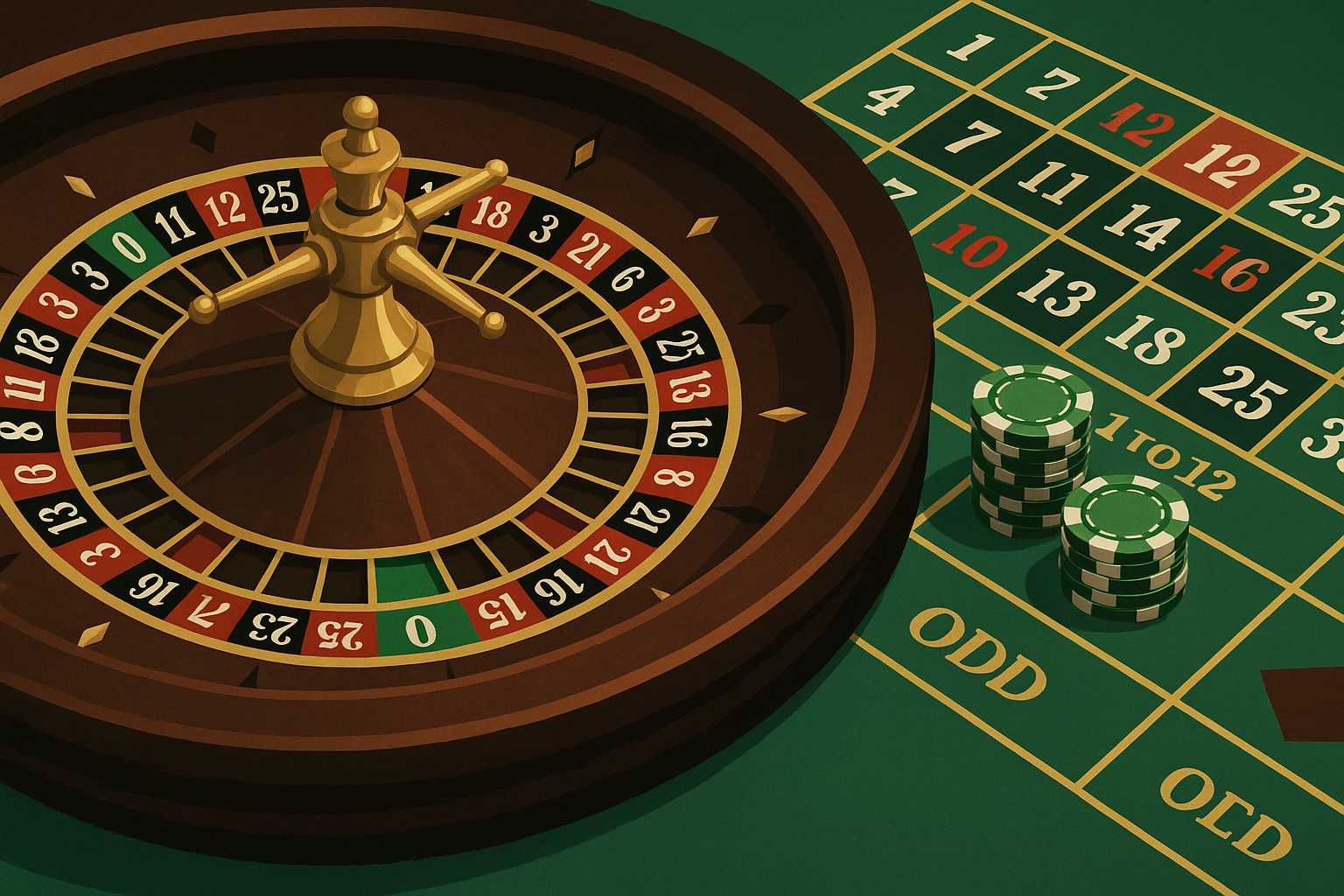
If you’ve ever watched the roulette wheel spin, you’ll know the green pockets do more than decorate the layout. With 0, and sometimes 00, they shape how odds, bets and payouts work.
Understanding what green payouts mean helps you see how each bet is priced and why results land the way they do. As a UK‑licensed operator, we like to keep the numbers clear so you can make informed choices.
Below, we walk through how green fits into every bet type, how the odds stack up, and how the house edge is calculated, so you know what you might expect before you place a chip.
What Are Green Payouts in Roulette?
In roulette, “green payouts” refer to the results of bets placed on the green pockets, the 0 in European roulette and the 0 and 00 in American roulette. These pockets are separate from the red and black numbers and are what give roulette its house edge. A European wheel has 37 pockets in total, while an American wheel has 38, so the presence of the green pockets changes the probabilities and keeps the returns to players below 100%.
A green bet usually means placing a chip directly on the 0, or 00 on American tables. This is called a straight-up bet and it pays 35 to 1 if the ball lands on that green number. You can also include the green pocket in combination bets. On European layouts you can make splits such as 0-1, 0-2 or 0-3, which pay 17 to 1, or the first four bet on 0-1-2-3, which pays 8 to 1. On American layouts there may also be splits involving 00, and a five-number “top line” bet on 0-00-1-2-3 that pays 6 to 1. Table rules can vary, so check the bet options where you play.
Green payouts are separate from red and black bets, and none of the even-money bets such as red or black, odd or even, or high or low include the green spaces. That gap is why the house edge exists. When 0 or 00 land, those even-money bets usually lose. Some European and French tables offer rules such as La Partage or En Prison on even-money bets, where a 0 result can return half your stake or hold it for the next spin. These rules reduce the effective edge on those wagers.
The size of the house edge depends on the wheel and the bet type. On a standard European wheel it is about 2.70%. On an American wheel it is about 5.26%, and the five-number top line bet carries a higher edge again. These figures reflect the fixed maths of the game.
Roulette is a game of chance and every spin is random. No outcome can be predicted. Online versions use certified random number generators and, in live games, each spin is independent of the last. No staking system can change the odds. If you choose to play, keep control of your spend, set limits, and only bet what you can afford to lose.
Why Does Roulette Have Green Pockets?
Roulette wheels include green pockets for a clear reason rooted in the game’s history. When roulette took shape in the 18th century, the green 0 was introduced to give the house a small, consistent edge over players. The colour also set zero apart from the red and black numbers so results were clear at a glance.
This simple design choice means the true odds of certain bets do not quite match the payouts, creating a built-in advantage for the casino. For example, a straight-up bet pays 35 to 1, yet on a European wheel the chance of any single number landing is 1 in 37, and 1 in 38 on an American wheel. In European roulette there is one green pocket, 0, while American roulette has two, 0 and 00.
That difference underpins the house edge you will often see quoted: around 2.70% on European wheels and about 5.26% on American wheels. Some UK tables use la partage or en prison on even-money bets, returning or holding half the stake when zero lands, which reduces the edge on those specific bets to roughly 1.35%.
Regulations have kept this feature as a standard part of the game. Operators must make rules and payouts clear and ensure equipment is tested so outcomes are random within the stated rules. The presence of green pockets is not just tradition, it is central to how roulette is balanced and licensed in the UK and beyond. Understanding that foundation makes the odds and payouts in the next sections much easier to follow.
Understanding the Odds for Green Bets in Roulette
When you place a bet on a green number on a European wheel, you are backing one outcome out of 37 possible results, numbers 0 to 36. On a European layout there is only one green pocket, 0.
Statistically, there is a 1 in 37 chance, about 2.7%, that the ball will land on 0. That figure stays the same for every spin and does not change with previous results. The payout for a successful green straight‑up bet is 35 to 1, paid as 35 units plus your stake; since the true odds are 36 to 1, that gap creates a house edge of about 2.7%.
These odds reflect the pure randomness of roulette. Each spin is independent, so nothing can influence the next outcome. Set a budget and stick to it. With that in mind, let’s see how this compares with red and black.
How Do Green Bet Payouts Compare to Red and Black?
On a European table, betting on the green 0 pays 35 to 1. That means a winning £1 chip returns £35 in winnings plus your £1 stake, for £36 back in total. A bet on red or black pays even money, so a winning £1 chip returns £1 in winnings plus your £1 stake.
The gap in payouts reflects the chances of success. There is only one green pocket on a 37-pocket wheel, so the chance of a green straight‑up win is 1 in 37, about 2.7%. Each of red and black covers 18 numbers, so the chance of hitting your chosen colour is 18 in 37, about 48.6% on any given spin.
Despite the higher payout on green, the returns are balanced by the house edge. On a European wheel the true odds of a single number are 36 to 1 but the game pays 35 to 1, and even‑money colour bets lose when the ball lands on 0. Both outcomes create the same house edge of 2.70%.
Although green pays more, the probability of landing on it is lower than landing on red or black. No bet type can guarantee an outcome, so it helps to weigh risk and return before you place your chips. If you are comparing tables, be aware that American wheels include 0 and 00, which lowers the chance of any colour winning and increases the house edge.
What Types of Green Bets Can You Make in Roulette?
Green bets focus on the 0 on European wheels and the 0 and 00 on American wheels. The most common is the straight‑up bet, placing your chip directly on a green number. Depending on the wheel and layout, there may be a few additional ways to include green in a wager.
It pays to know how these options work and what they return before you start, as that makes it easier to manage expectations.
Single Zero Versus Double Zero Wheels: The Impact on Green Outcomes
On a European table, the only green number is 0, so your direct option is a straight‑up wager on that pocket.
On American tables, there are two green numbers, 0 and 00. You can back either or both with straight‑up bets, and some layouts allow a split bet between 0 and 00. These choices slightly change the probability you are covering and the potential payout.
Always check which version you are playing and review the bet layout before you start, as the presence of 00 affects every wager on the table.
How Does the House Edge Relate to Green Bets?
The house edge in roulette is directly linked to the green pockets. On European wheels with a single 0, the house edge is about 2.7%. Over time, that means the casino keeps roughly £2.70 of every £100 wagered. This comes from the fact that zero turns some otherwise even contests into losing outcomes, and that payouts are set slightly below the true odds of winning.
On American wheels, which include both 0 and 00, the house edge rises to around 5.26%. The extra green pocket reduces the player’s chances on every bet, not just on green wagers. For instance, a straight-up number pays 35 to 1 but lands only once in 38 spins on average, which is how the margin is maintained.
In the UK, casinos almost always use single-zero European wheels, which keeps the house edge lower across the board. Some tables may also offer French rules such as La Partage on even-money bets, where half your stake is returned if zero lands. When available, that reduces the effective edge on those specific bets to 1.35%, so it is worth checking the table rules.
The edge applies regardless of the bet you choose, and it does not change with betting systems or past results. Treat roulette as entertainment, set limits, and only stake what you can afford. Enjoy the game for what it is, not as a way to guarantee winnings.
Common Myths About Green Payouts Debunked
One myth is that betting on green changes your overall odds in a special way. In reality, every spin of the wheel is independent and random, and on a European wheel a straight‑up bet on green has a 1 in 37 chance, about 2.7%.
Green does not carry any special weighting, and it pays the same as any other single number. On American wheels that have two green pockets, each individual green still lands about 1 time in 38, roughly 2.63%. Online roulette uses certified random number generators and, in live games, equipment is tested and maintained so outcomes remain independent.
Another misconception is about how the house edge works. It is created by the difference between the true odds of winning and the payout odds. For a straight‑up bet on any single number, including green, the payout is 35 to 1 while the true odds are longer, which is why the edge exists on European tables.
If the game paid 36 to 1 there would be no edge on that bet, but it does not. That gap gives an expected return of about 97.3% on European wheels and roughly 94.74% on American wheels for straight‑ups. Changing your stake size, switching numbers or using patterns does not reduce this margin.
Some players believe the green pocket is due after a run of reds or blacks. Past results do not affect future outcomes. Whether you bet on green or any other outcome, the mathematics of the wheel remains the same.
This belief is the gambler’s fallacy. Sequences can and do occur, and they do not make any next result more or less likely. Scoreboards showing recent, hot or cold numbers are for information only and are not a guide to what will happen next.
Are Green Bets Worth It in Roulette?
Some players assume green bets offer an advantage because of the higher payout. In truth, the return reflects the lower probability of success, and the house edge applies consistently to all bet types on the same wheel.
On European single zero wheels the house edge is typically 2.70%. American double zero wheels raise that edge, so the expected return is lower overall. The straight up payout on 0 or 00 is 35 to 1, but that does not change the underlying maths. It pays more because it lands less often. On some American layouts certain combinations that include 0 and 00 can carry a higher house edge than other bets, so it is sensible to check the table rules before you play.
It is also common to think that, after several spins without a green, the next result is more likely to be green. This is the gambler’s fallacy. Roulette results are independent, so there is never a guaranteed time for 0 or 00 to appear. Long runs without a zero can happen, and a zero can appear on consecutive spins as well.
No staking pattern can predict or change where the ball lands. A green bet is simply one of many choices on the felt. If you decide to include it, treat it as part of your overall approach and keep your play within sensible limits. Set a budget you can afford to lose, avoid chasing losses, take breaks, and consider using tools like deposit limits or time reminders if playing online.
Roulette Glossary: Essential Terms for British Players
Here are a few quick definitions to make the sections above easier to use at the table.
Straight‑Up Bet: A wager placed on any single number, including green 0. Pays 35 to 1 if the ball lands on your number.
Even‑Money Bet: A bet on large groups, such as red or black or odd or even. This pays 1 to 1, and green numbers are not included.
House Edge: The built‑in advantage the casino has on every wager. For European roulette this is 2.7%, due to the single green 0.
European Wheel: A roulette wheel with numbers 0 to 36. The 0 is green and creates the house edge on all bets.
American Wheel: A wheel with both 0 and 00, two green pockets, which raises the house edge to 5.26%.
Random Outcome: Every roulette spin is independent, and no patterns or systems can alter your odds.
Deciding whether to place a green bet is entirely up to you. The odds of winning are lower than broader bets, the payout is higher, and the house edge remains the same for equivalent bet types on the same wheel.
If you ever feel your gambling is not in control, support is available. Visit BeGambleAware.org or call the National Gambling Helpline on 0808 8020 133. Play sensibly, know the numbers, and enjoy the game on your terms.
**The information provided in this blog is intended for educational purposes and should not be construed as betting advice or a guarantee of success. Always gamble responsibly.