
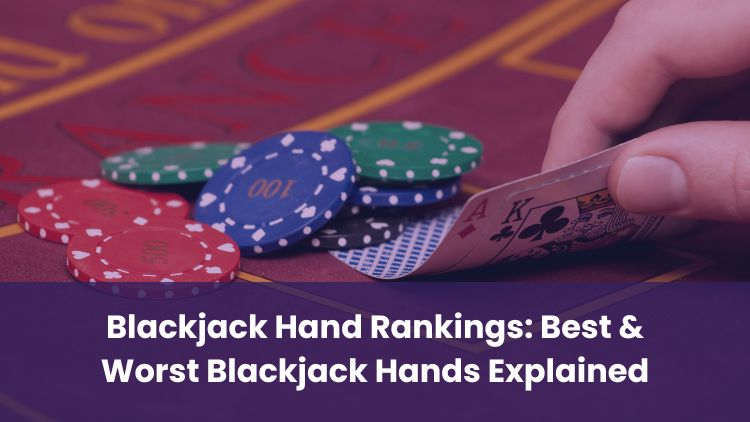
Understanding which blackjack hands give the most advantage, and which tend to put you on the back foot, is a useful place to start with this classic card game.
This blog post sets out how hands are valued, what counts as a natural blackjack, and the role of the Ace. It also explains the difference between hard and soft hands, and how outcomes such as wins, losses and pushes arise at the table.
We also clear up a few common mix-ups so newer players can read the game with more confidence. If you are curious about the best and worst hands, you will find clear answers below.
How Are Blackjack Hands Ranked?
In blackjack, a hand’s value is the total of its cards. Number cards count as their face value, while Kings, Queens and Jacks each count as 10. The Ace is flexible and can count as either 1 or 11, whichever gives the hand the stronger total without going over 21.
The highest possible hand is a “blackjack” or “natural,” which is an Ace with any 10-point card as the first two cards. All other hands are ranked by their total, with the aim of getting as close to 21 as possible without exceeding it.
Any total over 21 is a bust and loses immediately. Otherwise, the player’s total is compared with the dealer’s to decide the result. Because a natural has special treatment when it comes to payouts, it is worth looking at how that works next.
Blackjack (Natural) Payouts
A natural occurs when the opening two cards total 21, most often an Ace with a 10, Jack, Queen or King. It is the strongest start in the game and is usually paid at 3:2. For example, a £10 stake would typically return £15 in winnings plus the original £10.
Some tables pay 6:5 instead, which would return £12 on a £10 stake. Table rules vary, so it is always sensible to check the payout on naturals before taking a seat. With that in mind, it becomes clear why the natural is widely regarded as the best possible hand.
What Is the Best Possible Blackjack Hand?
The best possible hand in blackjack is a natural: two cards totalling 21, made up of an Ace and any 10-point card. It is only achievable with the first two cards and has its own payout rules, as noted above.
No three-card or longer combination can outrank a natural, even if it also totals 21. That special status is what sets it apart from every other result.
Of course, not every start is that strong, which brings us to the hands that tend to cause the most difficulty.
What Are the Worst Blackjack Hands?
Some totals are awkward because they leave little room for error. A hard 16, for example, often made up of a 10 and a 6 or a pair of 8s, sits in a tight spot. Drawing another card risks a bust, but standing can still lose to the dealer’s final total.
Hard 15 has similar problems. It trails many dealer outcomes and offers limited flexibility. Even totals in the 12 to 14 range can feel uncomfortable against a dealer’s higher upcard, as there is pressure to improve without tipping over 21.
Pairs of middling cards, such as 7 and 8 or 5 and 6, can also be challenging when they total 11 to 15 and the dealer shows strength. These spots do not decide the round on their own, but they often require careful judgment as the hand develops.
Hard Versus Soft Hands: What's the Difference?
In blackjack, hands are described as “hard” or “soft” depending on whether an Ace is being counted as 11.
A hard hand has no Ace counted as 11. If an Ace is present, it is treated as 1 to avoid going over 21. A 10 and a 7, or an Ace, 6 and 10 totalling 17, are both examples of hard 17s.
A soft hand contains an Ace that can be valued as 1 or 11, whichever keeps the total at 21 or below. A soft 17, made from an Ace and a 6, illustrates this flexibility. If another card is drawn and 11 would cause a bust, the Ace simply shifts to 1, which keeps more options open.
That flexibility leads naturally to the Ace itself, which changes hand values in a way no other card can.
How Does an Ace Change Hand Value?
As touched on with soft hands, the Ace is unique because it can count as 1 or 11. This allows the same set of cards to adjust as new cards arrive.
If an Ace and a 7 are held, the total is 18 when the Ace counts as 11, often called a soft 18. If another card is drawn and 11 would push the total over 21, the Ace switches to 1 instead. The ability to move between 1 and 11 can turn a potentially difficult position into one with more breathing room.
Understanding this switch helps explain why hands with an Ace are often more forgiving than similar hard totals.
Which Hands Beat the Dealer?
A hand beats the dealer when its total is higher than the dealer’s final total without going over 21. If the dealer stops at 18 and the player has 19 or 20, the player wins.
A natural blackjack (an Ace plus a 10-point card as the first two cards) beats any dealer total except another natural, which results in a tie known as a push.
If the dealer busts, any player hand of 21 or less wins automatically, even low totals. That outcome leads neatly into how ties are handled when neither side busts.
How Are Ties and Pushes Resolved?
A tie between player and dealer is called a push. This happens when both finish with the same total of 21 or less.
When a push occurs, the original stake is returned. There are no winnings, but there is no loss either. The next hand begins with a fresh bet under the table’s usual rules.
Pushes are part of the ebb and flow of blackjack and are most noticeable when both sides make 20 or when both start with naturals.
What Are Common Misconceptions About Blackjack Hand Rankings?
A frequent misconception is that any total of 21 is a blackjack. Only a two-card 21 made with an Ace and a 10-point card is a natural, which is why it has a distinct payout. A total of 21 reached with three or more cards is simply a strong total, not a natural.
Another misunderstanding is that certain hands are destined to lose. While some totals are tougher to manage, results always depend on how the dealer’s hand plays out and the final comparison of totals.
Some believe hard and soft hands with the same total are equivalent. In reality, a soft total can be more flexible because the Ace can shift between 1 and 11, which affects how safely an extra card can be taken.
It is also sometimes assumed that the player’s total alone decides the round. In blackjack, the dealer’s finished hand is always part of the outcome, which is why the same starting cards can lead to different results from one round to the next.
If you choose to play, keep control of your spend, set personal limits that suit your circumstances and take regular breaks. If gambling starts to affect your well-being or finances, seek support early. Independent organisations such as GamCare and GambleAware offer free, confidential help for anyone who needs it. With these basics in mind, you can approach hand rankings with clearer expectations and enjoy the game on your terms.
**The information provided in this blog is intended for educational purposes and should not be construed as betting advice or a guarantee of success. Always gamble responsibly.