
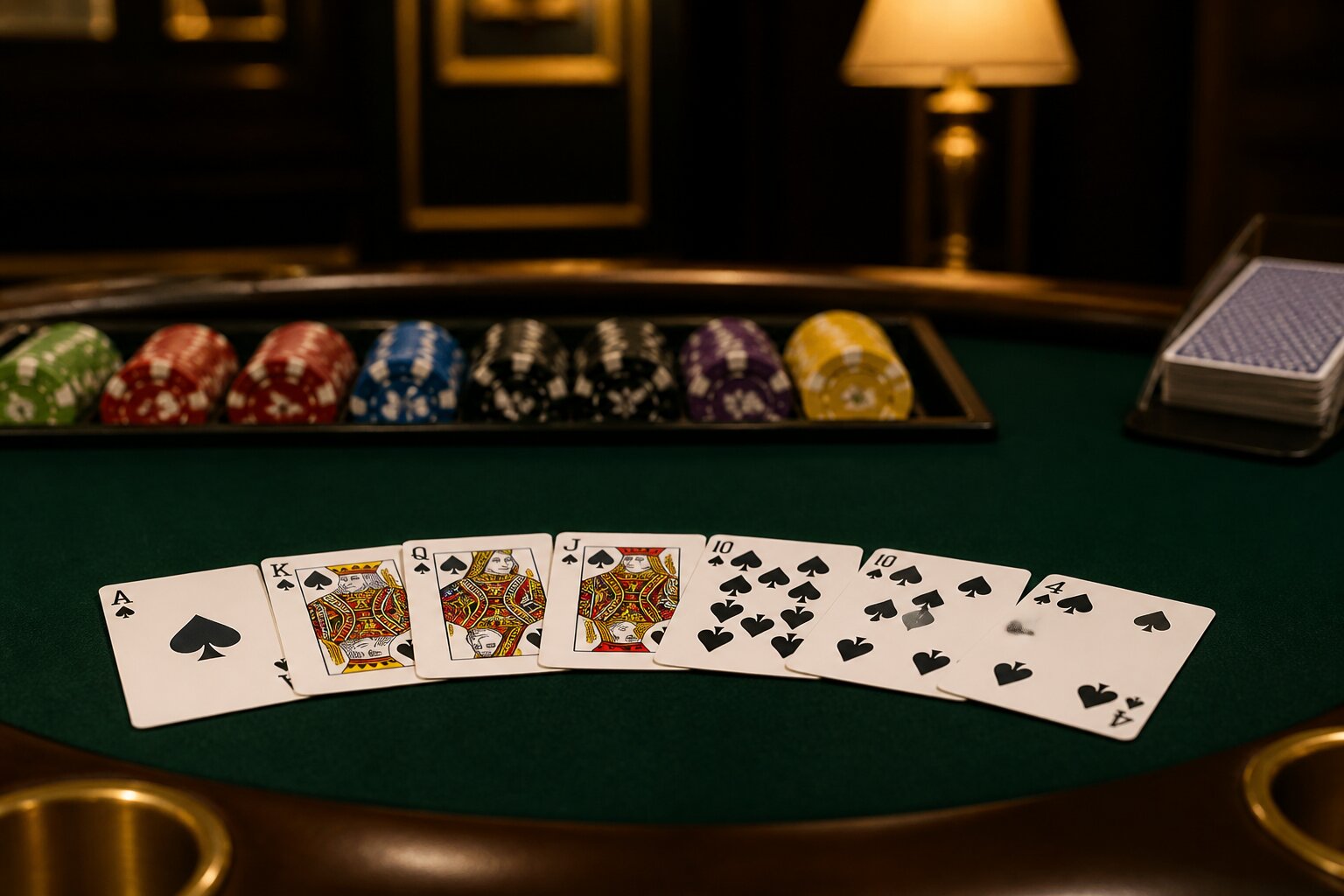
Blackjack is a game of clear rules and simple arithmetic. The value of each card determines how close your hand is to 21, and knowing those values makes the game far easier to follow.
You don’t need advanced maths to add up a hand; once you know what each card is worth and how aces behave, the rest follows naturally. Read on to learn how hand values work and how that knowledge shapes the choices you make at the table.
What Are the Standard Card Values in Blackjack?
Each card in blackjack carries a set value that applies regardless of its suit. Understanding these values is the first step to assessing any hand.
Here are the standard card values in blackjack:
- Number cards (2–10): Worth their face value. For example, a 7 is worth 7 points.
- Face cards (Jack, Queen, King): Each is worth 10 points.
- Ace: Can be worth either 1 point or 11 points, whichever benefits the hand without pushing it over 21.
For example, a King and a 5 add to 15, while an Ace and an 8 can be counted as either 9 or 19 depending on which helps the hand most. The flexibility of the ace is the key feature newcomers often notice next.
Why Are Card Values Important in Blackjack?
Card values define the whole objective of the game: reach as close to 21 as possible without exceeding it. Being able to total your hand quickly tells you how aggressive or cautious to be when deciding to take another card or stand.
If a hand totals 13, another card is likely to be safe; a total of 18, by contrast, makes another card risky. A Queen and a 6, for instance, give 16—a common “tipping point” where the decision to draw or not can swing the round. Understanding these thresholds helps you weigh the odds of improving your hand against the risk of going over 21. This clarity also makes it easier to follow strategic guidance and house rules that affect play.
If you want to see how these values are used during play, the next section explains how to calculate a hand step by step without getting bogged down in detail.
How to Calculate the Value of Your Blackjack Hand
Start by adding the face values of all cards in the hand, treating face cards as 10 and number cards at face value. The only special case is the ace, which is counted as either 1 or 11 in whichever way keeps the total at or below 21.
As an example, a 9 plus a Jack equals 19 (9 + 10). When an ace is involved, examine whether counting it as 11 would exceed 21; if it would, count it as 1 instead. So Ace + 7 counts as 18, but Ace + 7 + 5 must be scored as 13 because the ace becomes 1 to avoid going above 21.
Accurate calculation matters because it determines your options on each decision. Keep one clear bankroll limit in mind and play within it to maintain good control over your session.
What Does an Ace Mean in Blackjack?
The ace’s ability to be worth 1 or 11 makes it the most versatile card in blackjack. That flexibility lets a hand avoid busting while still aiming for a high total.
For instance, an Ace and a 6 can be 7 or 17; the higher value is used when it is legal to do so. An Ace combined with a King gives 21 when the ace counts as 11, which is the classic two-card blackjack. If further cards would make the total exceed 21 with the ace as 11, the ace automatically becomes 1 and the hand is adjusted accordingly.
This adaptive value means aces can sometimes keep a hand alive after drawing an extra card that would otherwise cause a bust. Next, the difference between soft and hard hands shows how that adaptability affects the choices a player can make.
Understanding Soft vs Hard Hands
The presence of an ace determines whether a hand is described as soft or hard, and that label affects the hand’s flexibility.
A soft hand includes an ace counted as 11, so the total can be reduced by 10 if the next card would otherwise create a bust. For example, Ace + 5 reads as a soft 16 because the ace can switch to 1 if needed. That flexibility often allows a player to take another card with less risk.
A hard hand either contains no ace or contains an ace that must be counted as 1 to avoid exceeding 21. A 10 and a 7 make a hard 17; an Ace + 7 + 9 also becomes a hard 17 because the ace must be 1 in that context. Knowing whether a hand is soft or hard helps frame the likely outcomes of taking another card. The next section clarifies how face cards fit neatly into these calculations.
How Are Face Cards Counted?
Face cards—Jack, Queen and King—each carry a fixed value of 10 points. This consistency simplifies arithmetic when they appear in a hand.
If you are dealt a King and an 8, the total is 18. Two face cards such as a Jack and a Queen give a total of 20. Because their value never changes, face cards are predictable building blocks in many hands and often lead to totals that require careful judgement about drawing further cards.
That predictability makes it easier to calculate the risk of taking another card and to compare different hands at a glance. In many card games the fact that face cards are always worth ten helps players form useful strategies without having to remember special cases.
Understanding fixed values like these makes it simpler to evaluate combinations such as pairs, which the next section explores.
What Happens with Double Aces or Pairs?
Pairs in blackjack are handled according to simple addition unless a split option is chosen by the player, in line with the house rules.
Two aces together cannot be treated as 22. Instead, one ace is counted as 11 and the other as 1, giving a total of 12. Many games allow splitting a pair, so two aces can become two separate hands, each starting with an ace that will be valued as 1 or 11 depending on the next card dealt to that hand. For other pairs, the total is the sum of the two identical cards—two 8s make 16, for example—and splitting creates two hands each beginning with an 8 plus the next card dealt.
Knowing how pairs work helps you see why splitting is sometimes offered: it converts a single awkward total into two new opportunities, though the desirability of splitting depends on the specific cards involved and the game rules in play.
Common Myths About Blackjack Card Values
There are a few persistent misunderstandings about card values that are worth clearing up so play is based on fact rather than belief.
Some players assume face cards have different values from each other; in truth Jack, Queen and King are all valued at 10. Another misconception is that an ace can be freely toggled between 1 and 11 at any moment by choice—actually it becomes 11 only when that does not make the hand exceed 21 and otherwise counts as 1 automatically. Finally, identical cards do not carry any special bonus simply because they match; a pair’s value is only the sum of the cards unless a split is chosen.
Remember to manage your spending and time at the table; keeping control ensures the game remains an enjoyable activity for everyone involved.
Play Casino Games at Thor Slots
Step into a world of choice at Thor Slots, where we offer plenty of ways to enjoy yourself. With a wide variety of casino games to suit all kinds of preferences, there’s always something to discover on our site.
Getting started is straightforward—just create your account, make a deposit and you can begin your experience with us. We look forward to welcoming you.
**The information provided in this blog is intended for educational purposes and should not be construed as betting advice or a guarantee of success. Always gamble responsibly.