
Are you searching for the secret pattern that could help you win at baccarat? Stories about hidden patterns and unbeatable systems are everywhere—promising that a simple formula will suddenly make the game predictable.
You may have seen streak trackers, zigzag charts or been told there is a perfect moment to bet. Those ideas can be alluring, but they deserve scrutiny before you risk time or money.
This article separates fact from fiction and explains what patterns really mean in baccarat, so you can make informed choices at the table.
What Are Baccarat Patterns?
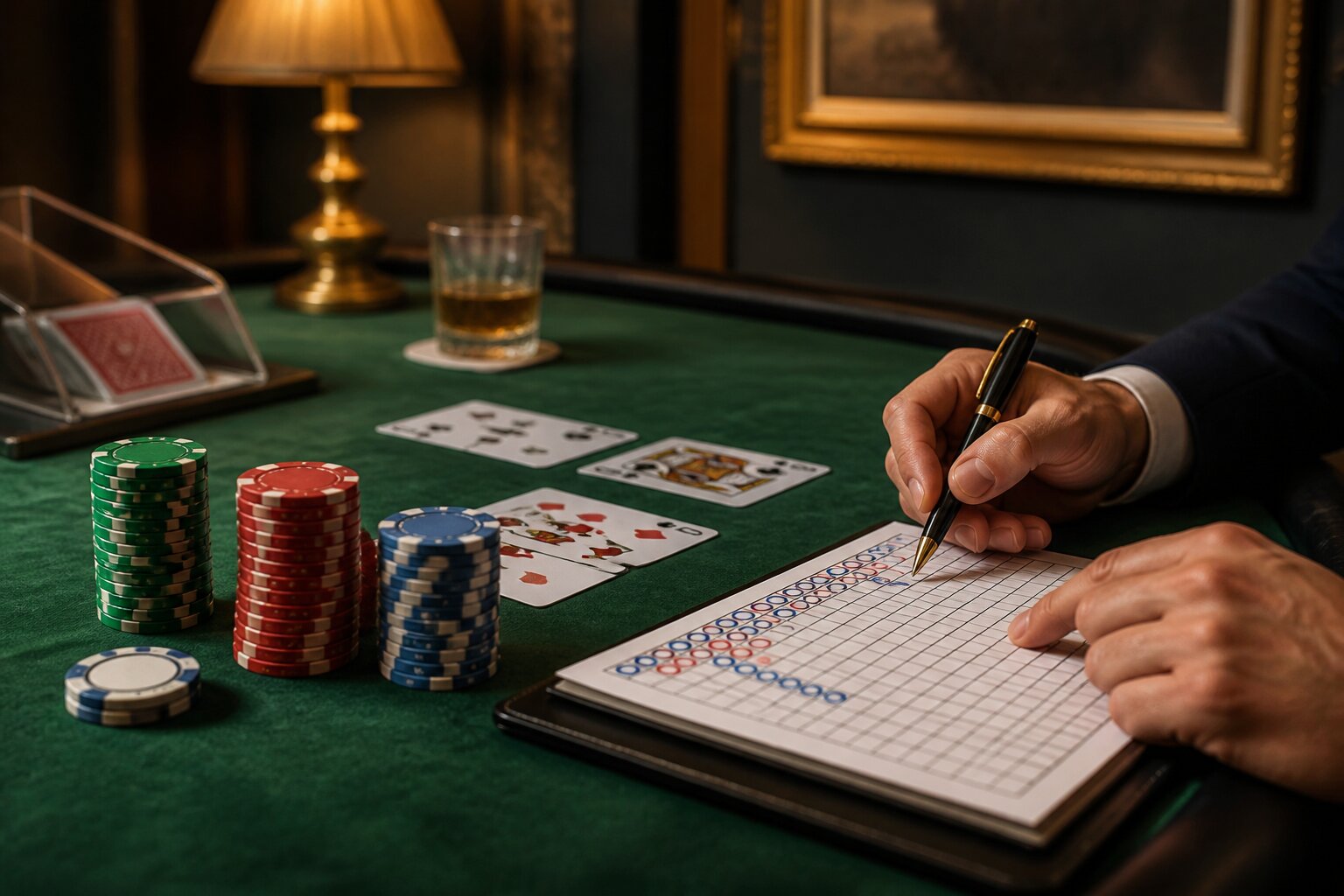
Baccarat patterns are visual records of previous results that some players study to spot trends. Common examples include the zigzag, where wins alternate between Player and Banker, and streaks, where one side appears to win repeatedly. Players often use scorecards or roadmaps to chart these results. The Big Road arranges outcomes in columns to make streaks obvious, while the Bead Plate shows results in a compact, sequential way.
These displays are simply ways to present past outcomes. They can make coincidences easier to notice, but they do not change how the cards are dealt or the probabilities that govern the game. Understanding what these charts show helps explain why so many players find patterns compelling even though those patterns do not alter future results. Next, we will look at whether any secret pattern can actually be used to predict what happens next.
Do Secret Patterns Actually Exist?
No reliable evidence supports the existence of secret, exploitable patterns in baccarat. The rules for drawing cards are fixed, and whether a game uses shuffled decks or a random number generator, each hand is produced independently. That independence means a previous result does not cause or influence the next one.
Independent testing of casino games confirms that outcomes follow the expected statistical distribution for the game, without hidden cycles that players can exploit. Regulated operators are required to use fair and tested systems, so results cannot be deliberately altered to create exploitable patterns. Because of this, attempting to find a hidden cheat or system in past results is unlikely to succeed. With that in mind, it is worth examining common pattern-based strategies and what they actually deliver.
Baccarat Pattern Strategies: Fact vs. Fiction
Popular approaches such as the Zig-Zag Zone or Streak Hunter claim to predict upcoming results by following visible trends. The Zig-Zag Zone advocates betting when outcomes alternate, while the Streak Hunter recommends sticking with an apparent run of the Banker or Player.
These methods rest on the premise that past outcomes influence future ones. In practice, however, each deal is independent and the long-term probabilities for each bet remain stable. For a typical eight-deck game the Banker wins around 45.8% of the time, the Player 44.6%, and a Tie about 9.6%. Those figures do not change because of a perceived pattern, so tracking results cannot shift the house advantage.
Belief in pattern systems can encourage chasing losses or increasing stakes without a sound basis. Rather than relying on past sequences, it is more useful to know what the fixed odds imply and to treat patterns as an entertaining way to follow the game rather than as a predictive tool. This leads naturally to the role that betting methods play in how players experience baccarat.
How Do Betting Systems Influence Baccarat Outcomes?
Players use betting systems to manage stakes and shape their session, with names like Martingale, Paroli and Fibonacci commonly discussed. The Martingale suggests doubling a stake after each loss so a single win would cover previous losses. Paroli advises increasing bets after wins to capitalise on a hot run. Fibonacci bases stake sizes on a mathematical sequence, increasing gradually after losses.
While these systems change how money is allocated from one round to the next, they do not alter the underlying probabilities or the house edge. Each hand’s outcome remains independent, so no sequence of bets can change the chances of winning or losing a particular deal. What betting systems do affect is the pattern of wins and losses a player experiences and how quickly a bankroll might grow or shrink.
Understanding that distinction helps set realistic expectations: betting systems can influence session dynamics but not the mathematical odds. To see why those odds matter, consider the probabilities that govern baccarat outcomes.
The Role of Probability in Baccarat
Probability governs the frequency with which each outcome should occur over many hands. For the main wagers in an eight-deck game, Banker wins near 45.8% of the time, Player around 44.6% and Ties roughly 9.6%. The house edge is about 1.06% on Banker bets, 1.24% on Player bets, and substantially higher on Tie bets.
These percentages describe long-run averages. If 1000 rounds were played under the same conditions, results would cluster around those proportions. Short sequences—two or three Banker wins in a row, for example—are normal within those averages but do not change the probabilities for the next deal. Recognising this helps explain why apparent patterns appear often but do not provide reliable signals for future outcomes.
Having covered the probability background, the next section looks at common misunderstandings that arise when players try to infer meaning from those short sequences.
Common Misconceptions About Baccarat Patterns
Several well-worn misconceptions lead players astray. One is the idea that an outcome is "due" after a run of the opposite result. This is the Gambler’s Fallacy: because each hand is independent, a recent sequence does not make any particular result more or less likely next time.
Another mistake is assuming patterns repeat from shoe to shoe. Each shoe is shuffled anew, so trends that were visible in one set of cards do not reliably reappear in the next. Players also sometimes overestimate the value of tracking tools, believing a roadmap will give a predictive edge. In reality these tools are records, not predictors.
These misconceptions can produce overconfidence and riskier choices. Recognising them reduces the chance of chasing imagined signals and helps maintain clearer judgement at the table. If you enjoy tracking for the social or observational side of play, it is worth doing so with that perspective. The next section considers whether tracking is worth your time.
Should You Use Pattern Tracking While Playing?
Some players enjoy charting results as a form of engagement. Using a roadmap or scorecard can make the session more sociable and give players something to discuss. It can also offer a structured way to observe how often outcomes occur, which some find satisfying.
There are downsides to tracking if it encourages belief in predictive power. Becoming convinced that a trend must continue or reverse can lead to higher stakes and chasing losses. For those who prefer to track, keeping it as an entertaining activity rather than a decision-making tool is the safest stance.
Practical safeguards such as setting time and spending limits, and using available player tools to control stakes, help keep sessions within enjoyable bounds. With a measured approach, pattern tracking can remain a recreational element without dominating betting choices. That brings us to a closing thought on how to approach baccarat overall.
Baccarat patterns are interesting to observe but they do not change what the mathematics of the game dictates; treating them as a pastime rather than a prediction method helps preserve enjoyment and clearer decision-making at the table.
Play Casino Games at Thor Slots
At Thor Slots, we believe playing casino games should be a relaxed and enjoyable experience from start to finish. If you’re looking for somewhere to unwind and explore a variety of games, our site is here for you.
Getting started couldn’t be easier – simply create your account, make a deposit and you’re all set to begin. We look forward to welcoming you and hope you find plenty of fun along the way.
**The information provided in this blog is intended for educational purposes and should not be construed as betting advice or a guarantee of success. Always gamble responsibly.